顯示具有 動物技術 標籤的文章。 顯示所有文章

2009年10月30日 星期五

澳洲產裂足虎的分子親緣關係以及澳洲東南部列足虎的分類檢討

文獻來源: Sistrom MJ, Hutchinson MN, Hutchinson RG, Donnellan SC. 2009. Molecular phylogeny of Australian Gehyra (Squamata: Gekkonidae) and taxonomic revision of Gehyra variegata in south-eastern Australia. Zootaxa 2277: 14–32.

Abstract
We provide the first phylogenetic hypothesis for the Australian species of the gekkonid genus Gehyra, based on 1044bp of the mitochondrial ND2 gene. Species representing the Asian, Melanesian and Australian radiations are resolved as separate clades, indicating relative isolation and independence of each of these evolutionary lines. Within the Australian radiation, the arid zone species form a monophyletic subgroup distinct from the remaining species found in tropical and warm mesic habitats. Extensive chromosome variation and highly variable external morphology have made species recognition difficult within Gehyra, exacerbated by the likely presence of numerous undescribed cryptic species. Three species of Gehyra are currently recognized in the southeastern inland of Australia, G. variegata, G. montium and G. purpurascens. We re-describe a fourth species, G. lazelli, to include those populations long referred to informally as the 2n=44 chromosome ‘race’ of Gehyra variegata. Gehyra lazelli widely overlaps the distribution of G. variegata in South Australia and the southern inland of New South Wales, with no suggestion of intergradation in morphology, mitochondrial DNA, allozyme variation or karyotype.

2009年5月6日 星期三

帶紋沙皮蛇發霉怎麼辦?

文獻來源: Lillywhite HB. 1998. Husbandry of the little file snake, Acrochordus granulatus. Zoo Biology 15(3): 315-327. [摘要連結]
延伸閱讀: Dunn R, Banks C, Birkett J. 2008. Exhibiting and breeding the Arafura file snake Acrochordus arafurae. International Zoo Yearbook 26(1): 98-103. Banks CB. 2007. Management of fully aquatic snakes. International Zoo Yearbook 28(1): 155-163.

[待完成]

Abstract
Aquatic snakes of the family Acrochordidae are unusual in terms of appearance, biology, and natural history. In spite of many attractive and fascinating features, there are few zoological exhibits of acrochordid snakes, and as a result many aspects of their husbandry are poorly understood. The present paper summarizes aspects of acrochordid biology related to health and welfare of captive snakes, with emphasis on the little file snake, Acrochordus granulatus. Several key points emerge having crucial relevance to successful husbandry. (1) File snakes are sensitive to low temperatures and to rapid thermal change. Captive snakes do well when maintained at water temperatures of 27-30°C and will not thrive if water temperatures are below 25°C. (2) File snakes can be kept in either fresh water or seawater. Snakes in sea or brackish water dehydrate, however, and must be allowed to drink fresh water periodically. If snakes from marine populations are maintained in saline water, 60-70% seawater is recommended. In all cases, water should be filtered or changed periodically to maintain quality. (3) File snakes feed almost exclusively on fishes which are usually captured in body coils. Snakes are more inclined to feed well if live prey are offered in shallow water where they are more easily captured. (4) File snakes are nocturnal and prefer quiescent seclusion within darkened refugia during daylight hours. Providing snakes with refugia such as sections of PVC pipe (which simulate burrows) helps reduce stress and improves the chances of snakes feeding regularly. (5) Snakes tend to burrow, and they locomote by crawling as well as by swimming. Use of sharp or rough materials in aquaria should be avoided because of possible skin abrasion which increases permeability and provides sites for bacterial infection.

圖片連結: David Behrens的pbase

2009年5月3日 星期日

兩生類繁殖飼養之廢水自動消毒系統

Fig. 1. Schematic of an automatic waste-water disinfection system designed for an amphibian captive-breeding and research facility: a, irrigation controller; b, relay for sump pump; c and d, power points; e, chemical dosing pump; f, pipe joiner to allow removal of pump for servicing; g, chlorine analyser; h, flow regulator; i, chlorine sensor probe; j, chlorine drum; k, chemical safety bund; l, flow-regulating valve; m, fine filter; n, submersible pump; o, float switch; p, circulation valve; q, discharge valve; r, holding/treatment tank; s, filter; t, UV treatment system; u, soak well; v, emergency overflow; w, inflow pipe and coarse filter; x, discharge pipe.

文獻來源: Robertson H, Eden P, Gaikhorst G, Matson P, Slattery T, Vitali S. 2008.
An automatic waste-water disinfection system for an amphibian captive-breeding and research facility. International Zoo Yearbook 42(1): 53-57. [摘要連結]

Abstract
When amphibians are brought into an amphibian facility, every precaution should be taken to prevent the introduction of diseases, including testing for chytrid fungus Batrachochytriumdendrobatidis. Equal consideration is recommended for the disinfection of waste products, including water, to prevent the spread of disease both within and between facilities, and to complete the biosecurity cycle. The disinfection of all waste products is particularly important when the facility houses amphibians from remote locations. This report describes an automated waste-water disinfection system (AWWDS) to disinfect waste water from amphibian enclosures and research facilities. The AWWDS is reliable as it does not rely on an individual's compliance to dosing protocols and it is economical because it reduces labour time. The AWWDS also provides an efficient infrastructure to disinfect the amounts of water produced by a moderate-sized busy amphibian captive-breeding and research facility.

2009年4月24日 星期五

紅蓮燈的緊迫程度可藉偵測其螢光光譜變化而得知

文獻來源: Brinn RP, Marcon J, Tavares-Dias M, Brinn IM. 2008. Fluorescence Detection of the Ornamental Fish Cardinal Tetra (Paracheirodon axelrodi). Photochemistry and Photobiology 85(1): 358-364. [摘要連結]

延伸閱讀: 綠蓮燈體色的日夜間變化

Abstract
The fluorescence spectra of the tropical fish, Cardinal Tetra (Paracheirodon axelrodi), originating in the Amazon region of Brazil, were determined. These spectra were then treated using factor analysis, generating two contributing spectra and separating out the noise. Time-resolved fluorescence results indicated that the fluorescent system in the epidermis undergoes excited state reaction. Excited state proton transfer is suggested as being present. Both intentionally stressed and nonstressed individuals were used and some small differences were noted in the contributions of the two calculated contributing spectra to the experimental spectra, presumably as a function of stress. The results are compared with those obtained by the standard determination of cortisol level using the whole body extraction method and it is suggested that the method could be tested as an improved, nondestructive way to determine stress in this species, which is a necessary step in the development of "best management practices" of methods for storage and transport of the fish.

2009年4月6日 星期一

使用半陰莖透視技術鑑識巨蜥的性別

文獻來源: Brown D. 2009. Hemipenal Transillumination as a Sexing Technique in Varanids. Biawak 3(1): 26-29. [全文下載]

巨蜥的性別鑑識一直是生態保育, 野外監測, 飼養繁殖上一個難題, 這篇短文簡單利用強光透視巨蜥尾部鑑識其性別. 不過此方法仍然有使用上的限制, 首先是受測的巨蜥皆為澳洲產小型種類, 而尾部直徑超過1cm便可能不適用, 另外受測時巨蜥情緒的穩定度也因種而異.


Abstract
A technique for assisting in the determination of gender in varanids of various ages is described. The technique, termed hemipenal transillumination technique or HTI technique, is based around the candling of the tail base using a bright light. The basic technique, technique variations and expected results are described.

2008年11月30日 星期日

[Article] 如何測定莫頓巨蜥的性別?

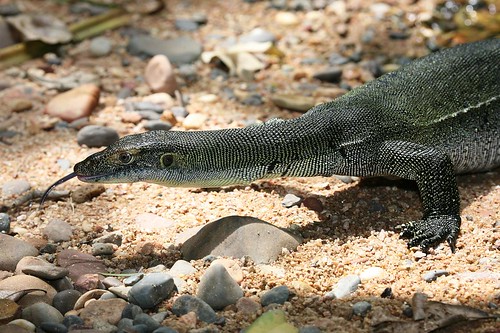
對生態學家來說, 如何在野外進行標放時測定巨蜥的性別一直是相當困擾的. 因為巨蜥通常具有強而有力的尾部與顎部, 而且不像一般爬蟲類容易徒手翻出半陰莖檢查性別. 這篇發表在紐約科學院年報的文章則說明研究人員成功地同時使用半陰莖翻出術(就是傳說中的偏覽教嗎?)以及測定血漿中的雄激素(androgens)與雌激素(estradiol)比進行性別的測定.

Successfully Determining the Sex of Adult Varanus mertensi (Reptilia: Varanidae) Using a Combination of Both Hemipenile Eversion and the Ratio of Androgens:Estradiol in Plasma

P.J MAYES a, , S D BRADSHAW b , F J BRADSHAW b

a Centre for Ecosystem Management, Edith Cowan University, Joondalup, Western Australia, Australia
b School of Animal Biology and Centre for Native Animal Research, University of Western Australia, Perth, Australia


Address for correspondence: P. J. Mayes, Centre for Ecosystem Management, Edith Cowan University, 100 Joondalup Drive, Joondalup, Western Australia 6027, Australia. p.mayes@ecu.edu.au


Abstract: In remote field localities, given limited access to specialized equipment, determining the sex of captured adult varanid lizards before release can be problematic. Determining the sex of the tropical semiaquatic Varanus mertensi, a species with significant tail musculature, is difficult using traditional hand-pressure-induced hemipenile eversion. As an alternative, we propose an extended technique for identifying the sex of adult V. mertensi. We recommend using a combination of the traditional field-based hemipenile eversion technique and a measurement of the ratio of androgens to estradiol in plasma samples taken from field-captured animals.

圖片連結: flickr中Macdonnelliensis所拍攝之圖片