文獻來源: Brown JL, Morales V, Summers K. 2009. Tactical reproductive parasitism via larval cannibalism in Peruvian poison frogs. Biology Letters 5(2): 148-151. doi: 10.1098/rsbl.2008.0591Abstract We report an unusual example of reproductive parasitism in amphibians. Dendrobates variabilis, an Amazonian poison frog, oviposits at the surface of the water in small pools in plants and deposits tadpoles within the pools. Tadpoles are highly cannibalistic and consume young tadpoles if they are accessible. Deposition of embryos and tadpoles in the same pool is common. Genetic analyses indicate that tadpoles are frequently unrelated to embryos in the same pool. A pool choice experiment in the field demonstrated that males carrying tadpoles prefer to place them in pools with embryos, facilitating reproductive parasitism via cannibalism.
圖片連結: www.dendrobates.org
 文獻來源: Birindelli, J.L.O. & Britski, H.A. (2009): New species of the genus Leporinus Agassiz (Characiformes: Anostomidae) from the rio Curuá, rio Xingu basin, Serra do Cachimbo, Brazil, with comments on Leporinus reticulatus. Neotropical Ichthyology 7 (1): 1-10. [全文下載] Abstract
A new species of Leporinus Agassiz is described from the rio Curuá, a tributary of the rio Iriri, rio Xingu basin, Serra do Cachimbo, Pará State, Brazil. The new species is diagnosed by the color pattern, which consists of eight to ten midlateral round dark blotches plus 20 to 40 smaller ones scattered over the body, dental formula 3/4, subinferior to inferior mouth, 37 to 38 lateral line scales, 4/3-4 transversal series of scales, and 12 circumpeduncular scale series. The new species most closely resembles L. octomaculatus and L. reticulatus from the upper Tapajós basin, and L. marcgravii and L. microphthalmus from the rio São Francisco and the rio Paranaíba, respectively. Based on recently collected specimens, L. reticulatus is re-diagnosed as having an allometric elongation of the snout.
 文獻來源: Birindelli, J.L.O., Zanata, A.M., Sousa, L.M. & Netto-Ferreira, A.L. (2009): New species of Jupiaba Zanata (Characiformes: Characidae) from Serra do Cachimbo, with comments on the endemism of upper rio Curuá, rio Xingu basin, Brazil. Neotropical Ichthyology 7 (1): 11-18. [全文下載]AbstractA new species of Jupiaba is described from rio Curuá, a tributary of the rio Iriri, rio Xingu basin, Pará State, Brazil. The new species is distinguished from its congeners by the unique combination of teeth cusps of similar size, dentary teeth gradually decreasing in size towards posterior portion, color pattern consisting of dark markings on the base of the majority of lateral body scales, inconspicuous dark elongate humeral blotch and conspicuous dark round blotch on the caudal peduncle, and 21 to 24 branched anal-fin rays. The new species is very similar, and possibly sister taxon to J. meunieri. Comments on the endemism of the fish fauna of the upper rio Curuá are given.
 文獻來源: González-Bergonzoni, I., Loureiro, M. & Oviedo, S. (2009): A new species of Gymnogeophagus from the río Negro and río Tacuarí basins, Uruguay (Teleostei: Perciformes). Neotropical Ichthyology 7 (1): 19-24. [全文下載]The new cichlid species Gymnogeophagus tiraparae is described from the río Negro and río Tacuarí basins (Uruguay). The new species is distinguished from other Gymnogeophagus species by the unique presence of the following characters: adipose hump on head deeper than the dorsal-fin upper border, adipose hump with anterior profile vertical, extending from the upper lip to the dorsal-fin origin, absence of transversal bands on body; two horizontal series of moderately elongated light blue dots between dorsal fin spines, and a series of light blue stripes between soft rays, sometimes merged with the second series of elongated dots, always with a red ground color between series of dots, and caudal fin with dots vertically aligned on its distal border. According to these characters and a recent molecular phylogenetic analysis, the new species is closely related to G. gymnogenys.
 文獻來源: Garavello JC, Santos GM. 2009. Two new species of Leporinus Agassiz, 1829 from Araguaia-Tocantins system, Amazon basin, Brazil (Ostariophysi, Anostomidae). Brazilian Journal of Biology 69 (1): 109-116. [全文下載]
Abstract Two new species of genus Leporinus from the Araguaia-Tocantins system, Amazon, Brazil, are described. Leporinus unitaeniatus n. sp. is distinguished from the remaining species of this genus by the presence of a conspicuous longitudinal dark brown bar along the lateral line on the flanks, and Leporinus geminis n. sp. is distinguished by an inconspicuous dark bar combined with three large and vertically elongated brown blotches on the trunk; the first on the dorsal fin region, the second anterior to the adipose fin and the third on the caudal peduncle. Both are medium-sized species of the genus (up to 150 mm SL) and share the following combination of meristic characters: 4 teeth on each premaxillary and dentary; 40-43 scales in the lateral line, 6/I/5 scales on the transversal line, and 16 series of scales around the caudal peduncle. L. unitaeniatus n. sp. has a sub-terminal mouth and tooth series formed by incisive-like elongated teeth frontally turned and with only a straight cutting edge decreasing in size like the steps of stairs from the teeth pair of symphysis. Leporinus geminis n. sp. has a sub-inferior mouth and the tooth series shaped by large incisive-like teeth forming an arched cutting edge, decreasing in size from the symphysal pair of teeth.
圖片連結: 雷魚圖鑑 (此圖並非L. unitaeniatus或L. geminis, 只是一個在斑紋上較近似的種類)
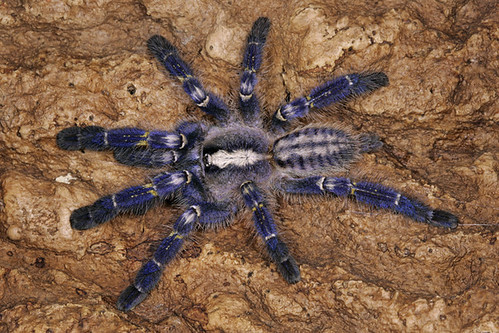
 雖然Aphonopelma與Brachypelma兩個屬的捕鳥蛛才剛被正式被列入CITES附錄(但不被野動法所管制)(註一), 但俗稱華麗雨林屬的Poecilotheria是否應被列入CITES管制也開始被討論著. 其實這是一個老話題. 早在2000年在肯亞奈洛比所召開的第11次大會中, 斯里蘭卡與美國就共同提案建議將整個屬列入CITES II進行貿易管制, 主要是因為斯里藍卡認為因為寵物貿易而自斯里藍卡走私華麗雨林蛛已經嚴重危害到該國的自然資源(註二), 不過該芻議並未在該次大會通過. 在2008年底, 世界自然保育聯盟(IUCN)正式將印度產的數種捕鳥蛛列入評估與觀察名單(參見Molur et al.之文章). 然而英國捕鳥蛛學會(BTS)的主席Andrew Smith於去年底正式發出一份聲明, 認為這些捕鳥蛛之所以能夠被印度的保育團體建議置入IUCN的Red List乃是因為這些保育團體打算利用這些捕鳥蛛籌措經費, 並且希望將這些捕鳥蛛或整個屬一舉送進CITES appendix, 如此一來保育團體的經費便無後顧之憂, 這也就是說, 將這些捕鳥蛛送進IUCN Red List並非科學與保育考量, 而只是基於不科學的生態保育信仰的政治操作. Smith認為, 根據英國捕鳥蛛學會多年的研究, Poecilotheria整個屬(除了P. hanumavilasumica這個瀕危種之外)與其它被送進IUCN Red List的物種無一是瀕危物種. 他並指出許多所謂的保育團體根本缺乏專業的知識與調查方法, 然後呼天嗆地地宣告這些生物難以人工繁殖, 因此需要藉由國際貿易來管制. 這系列的討論在許多的捕鳥蛛論壇上仍被討論著, 日後這些物種是否真會被送進CITES appendix則有待觀察.
註一: CITES所管制的是國際邊境貿易, 也就是說進出口時若無法提出合法的CITES文件就算是走私, 而野動法管制的是國內的部份, 然兩屬捕鳥蛛在新版的野動法保育名單中(2009/04/01起生效者), 並未被包含.
註二: 在當代保育生物學與國際生物多樣性政策的思潮中, 生物資源的"宗主國"是否能夠因為該國(及其人民)是否因為其所特有的生物資源被合理利用而受惠是一個倍受關切的話題. 不過目前因為寵物市場而產生的野生物貿易中, 所謂的"第三世界國家"(這本身是個歧視性名詞)能夠掌握生物資源輸出的主動權, 並進行有效保育管理及利用的例子仍然非常少.
圖片連結: 8legs2fangs之flickr相簿
 文獻來源: Ottoni, F.P. & W.J.E.M. Costa. 2008. Taxonomic revision of the genus Australoheros Rícan & Kullander, 2006 (Teleostei: Cichlidae) with descriptions of nine new species from southeastern Brazil. Vertebrate Zoology 58 (2): 207-232. [全文下載]
Abstract
Nine new species of Australohero from Southern Brazil are herein described: Australoheros austrani from rio Sao Joao basin; A. barbosae from rio Preto basin, rio Paraiba do Sul basin; A. ipatinguensis from rio Doce basin; A. macacuensis from rio Amcacu basin, A. macaensis from rio Macae basin, Amuriae from rio Muriae basin, rio Paraiba do Sul basin; A. paraibae from rio do Peixe basin, rio Paraiba do Sul basin; A. robustus from corrego da Areia basin, rio Paraiba do Sul basin; and A. saquarema from lagoa de Saquarema system. The new species are easily distinguished from their congeners from South Brazil, Northern Argentina and North Uruguay (except A. scitulus) by having 12 caudal vertebrae (vs. 13 or more). The new species are distinguished from A. scitulus and A. forquiha by having no dark marks on side of head (vs. dark marks present on side of head), and differ from A. ribeirae by meristic counts. the nine new species differ from each other by several meristic counts, some morphometric measurements, shape of the snout and color pattern. A new phylogeny of the genus is required, because when these new species from Southern Brazil are included into the groups proposed by Rican & Kullander (2006, 2008), the characters turns incongruent.
有關A. ribeirae之原始描述請由此下載, 此外請參見Cichlidae.com對本屬的介紹
圖片連結: aquapage.net (credit: eric1968)
 2009年04月05日蘋果日報 【郭睿誠╱台中報導】
一條闖入民宅的保育類黑眉錦蛇,遭屋主處以「砍頭私刑」,還將錦蛇身首異處的死狀貼上部落格,宣稱「私闖民宅一律死路一條」,遭網友圍剿痛批「廢人」、「變態」,有人截取其網頁向警政署森林暨自然保育警察隊報案;森林警察表示,保育動物若危害民眾時雖可殺害,但事後仍需通報,否則恐違《野生動物保育法》,近日將追查版主到案。
稱「闖民宅死路一條」
網友leejh0523今年2月底在其部落格(http://www.wretch.cc/blog/leejh0523/23161192)發表一篇《錦蛇》文章,裡面有3張黑眉錦蛇被斷頸的血淋淋照片,還加註「最好每個人都有那個鬼時間等消防隊」、「很不幸的家裡有其他動物,而且還有人怕蛇,私闖民宅一律死路一條。」(註: 該文章已被鎖定, 不過已有網友將其原文與照片轉載於其它位置存放) 結果湧入40多篇回應,網友garlicat表示:「雖然我不喜歡蛇,不過我更賭爛你的做法,真他媽心理變態!」還有網友直指:「錦蛇又沒毒…… 黑眉錦蛇是台灣的寶,任意虐殺是不道德的行為。」警政署森林暨自然保育警察隊東勢分隊吳姓警員昨證實,有接獲網友檢舉此案,近日將追查版主到該分隊說明案情。 台中縣政府農業處保育科長李代娟指出,《野生動物保育法》規定,動物若有危害民眾生命安全之虞雖可直接殺害,但須通報、且不得公開展示,否則可處一萬元以上五萬元以下罰鍰,「將蛇剁頸又張貼上網,實在太過分」。
黑眉錦蛇小檔案
◎學名:Elaphe taeniura friesei (目前有效學名應該是Orthiophis taeniura friesei)
◎保育等級:三級,屬應保育的野生動物
◎特徵: 無毒大型蛇,身長可達2公尺以上,全身布滿黃色與黑色花紋,頭部兩側各有一條明顯的黑帶。
※資料來源:台中縣政府農業處
圖片連結: reptilis.org
 文獻來源: Whilea GM, Ullerb T, Wapstraa E. 2009. Family conflict and the evolution of sociality in reptiles. Behavioral Ecology 2009 20(2):245-250; doi:10.1093/beheco/arp015
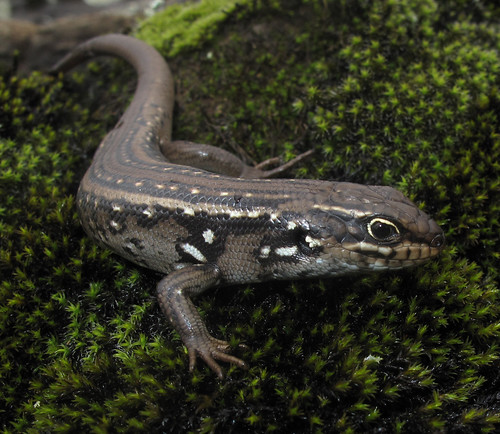
俗稱刺尾岩蜥(對, 就是那個貴翻天的刺尾岩蜥)的Egernia屬石龍子在爬蟲學研究中是一個非常重要的類群, 因為牠們展現了極為複雜的社會性行為. 在此所談的社會性(sociality)並非如人類社會的角色分工, 而是廣義的, 在社會生物學中所關注的, 在形成真社會性(eusocial)生物前所可能經歷的行為演化歷程. 生物的社會化過程中被預測一定要發生的現象, 除了非生殖方面的性別分工, 或同一性別內的角色分工(如職蟻, 兵蟻)之外, 小家庭與一夫一妻制的形成都被認為是獨居生物步入社會型生物演化的里程碑之一, 然而小家庭與一夫一妻制的形成, 在演化上事實上有著許多利幣得失, 這篇文章便是藉著對懷特氏刺尾石龍子(E. whitii)的研究提出一些觀點. Egernia屬石龍子是蜥蜴中少數具有親代照護行為的類群, 而他們的小家庭通常由一對終生奉行一夫一妻制的父母與其北鼻所構成. 由於一個家庭的領土通常由雌性所踞守, 因此雌性便無法進行多次的配對(multiple mating), 而且出現在領土內的非婚生北鼻就會被爸爸所趕走甚至被咬死. 這樣更會增加媽媽與北鼻在一個家庭內的利益衝突. 這篇文章的主旨便在於探討天擇力量如何促進親代照護的穩定, 遺傳層面的配對忠誠度, 以及這些因素對於促進生物社會化以及社會化的龐雜度.
Mating systems and parental care are predicted to coevolve because the former dictates the cost–benefit ratio of the latter by affecting genetic relatedness between adults and offspring. Reptiles show only rudimentary forms of sociality and parental care and, hence, could provide important insights into the early stages of the evolution and maintenance of social systems. The skink genus Egernia exhibits the most complex form of sociality and parental care in lizards, with the formation of stable social groups typically consisting of a monogamous pair and their offspring. Here we show that, within a social group, offspring sired by males other than the social father are restricted to the area of the parental home range that is occupied exclusively by the mother. Thus, males rarely tolerate offspring within their home range that they are not genetically related to. This may increase the cost of multiple mating for females and offspring via increased risk of infanticide, reduced parental tolerance, and increased mother–offspring competition. We outline a verbal model for how this could generate a feedback loop in which selection favors reduced multiple mating by females and increased paternal care, thereby setting the stage for the evolution of complex sociality and genetic monogamy.
圖片連結: pokerchampdaniel的flickr相簿
 文獻來源: Dijkstra PD, Hemelrijk C, Seehausen O, Groothuis TGG. 2009. Color polymorphism and intrasexual competition in assemblages of cichlid fish. Behavioral Ecology 2009 20(1):138-144; doi:10.1093/beheco/arn125
馬拉威湖產慈鯛Pundamilia(台灣沒有引進作為觀賞魚用)長久以來一直是研究性擇的重要物種, 在許多的普通生物學教科書中都已經成為經典的研究案例. 近年的研究多半著重在兩個領域, 性擇, 雜交與種化的發生機制(見科景的文章)以及種內(或種間)不同色型雄魚的競爭以及不同色型如何在棲地中達成共棲(co-existence). 過去的研究認為紅色雄魚(nyererei)相對於藍色雄魚(pundamilia)較具優勢, 因此紅色型可能在某些棲地中取代藍色型, 然而Dijkstra et al.的研究指出種內競爭事實上多發生於同色型的雄魚間, 而由於這樣的行為使得各種色型的雄魚得以共存, 並且在演化上維持體色的多型性. 這樣的研究事實上對於養殖也有重要的啟示, 在許多的慈鯛科魚類論壇中經常可見有關魚種搭配以及避免種內或種間攻擊的討論, Fluntzis這篇短文可提供一些參考.
Abstract
The origin and maintenance of phenotypic polymorphisms is a classical problem in evolutionary ecology. Aggressive male–male competition can be a source of negative frequency-dependent selection stabilizing phenotypic polymorphisms when aggression is biased toward the own morph. We studied experimental assemblages of red and blue color morphs of the Lake Victoria cichlid fish Pundamilia. Aggression was investigated in mixed-color and single-color assemblages. We found that aggression was indeed biased toward males of the same color, which could in theory reduce aggression levels in mixed-color assemblages and promote coexistence. However, previous studies showed high aggression levels in red and dominance of red over blue males in dyadic interactions, which could hinder coexistence. We found that coexistence in mixed-color assemblages reduced the level of aggression in red males but not in blue males. Red and blue males were equally dominant in mixed-color assemblages, suggesting that predictions derived from dyadic interactions may not be valid for an assemblage situation. The results are consistent with field data: the geographic range of red is nested within that of blue, suggesting that red cannot displace blue. Our study suggests that male–male competition may be a significant force for maintaining phenotypic diversity.
圖片連結: livescience.com
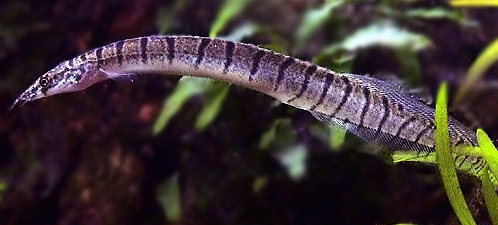
 Channa pulchra 幻彩紅寶石雷龍 x 1
今天的重點是, 又撿到便宜, 為什麼很便宜就私下再說啦~~~Channa pulchra倒底有沒有分什麼藍型黃型, 其實我們在看了這麼多魚以後看不太出來耶. 至於我們在4月1日買到的"斯里蘭卡藍霓虹雷龍"應該就是這隻, 而"馬來西亞產的彩虹雷龍"則是這隻.
魚隻來源: 北高雄水族(明誠店)
圖片連結: amiidae

 文獻來源: Day JJ, Bills R, Friel JP. 2009. Lacustrine radiations in African Synodontis catfish. Journal of Evolutionary Biology 22: 805-817. [摘要下載]Abstract
Synodontis catfish are a species-rich, tropical pan-African genus that predominately occur in fluviatile environments, but which also form a small radiation within Lake Tanganyika (LT). Here we estimate Synodontis relationships, based on mitochondrial and nuclear DNA, greatly expanding previous sampling. Data were analysed using different methods of phylogenetic inference: Bayesian (also testing compositional heterogeneity), likelihood and parsimony, in order to investigate biogeographic history and the extent of intralacustrine speciation within this group. Bayesian-relaxed clock analyses were used to estimate timings of radiations. Our analyses reveal a single origin of the LT flock with the inclusion of the nonendemic S. victoriae, and that these taxa evolved relatively recently (5.5 Ma), considerably later than the formation of LT (9–12 Ma). Two internal endemic clades diversified at a similar time (2–2.5 Ma), corresponding to a period of climate change, when lake levels dropped. We find evidence for a further species flock, composed of riverine southern African taxa, the diversification of which is very rapid, 0.8 Ma (95% HPD: 0.4–1.5) and infer a similar scenario for the diversification of this flock to southern African serrachromine cichlids in that they radiated in the now extinct lake Makgadikgadi. We also reveal that the biogeographic history of Synodontis catfish is more complex than previously thought, with nonmonophyletic geographic species groupings.
圖片連結: Scotcat
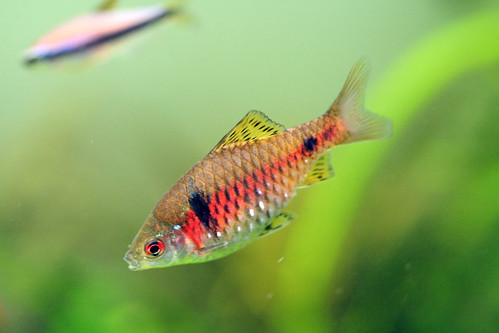
 文獻來源: Kullander SO, Britz R. 2008. Puntius padamya, a new species of Cyprinid fish from Myanmar (Teleostei: Cyprinidae). Electronic journal of ichthyology 4(2): 56 - 66. [全文下載]
Abstract
Puntius padamya, new species, is described from the type locality near Mandalay, in the Ayeyarwaddy River drainage, Myanmar. Referred specimens are reported from the lower Chindwin River. Puntius padamya is distinguished from other species of the P. conchonius species group above all by the colour pattern. Males possess a broad red band from the head to the base of the caudal fin, abdominal scales with dark margins, and hyaline dorsal,
anal and pectoral fins with conspicuous black spots and black distal margins. Both sexes possess a vertically elongate dark humeral blotch and a small, inconspicuous dark blotch on the side of the caudal peduncle. Puntius padamya is a well known aquarium fish, commercialized as “Odessa barb”.
另可見practicalfishkeeping之解說與此處之飼養建議
圖片連結: sakichin之flickr相簿


 文獻來源: Pouyaud, L. , Sudarto, and G. G. Teugels. 2003. The different colour varieties of the Asian arowana Scleropages formosus (Osteoglossidae) are distinct species: morphologic and genetic evidences. Cybium v. 27 (no. 4): 287-305. [全文下載]
其實我們對龍魚一點也不熟, 對龍魚也沒啥興趣(大概是所有骨舌魚裏面除了七星飛刀外我們最沒興趣的魚), 不過看到這篇讓我們覺得有點後知後覺: 原來有人已經把紅龍拆解四個種啦? 但是為什麼IUCN與CITES都沒有隨之調整? 為什麼也沒有後續的討論? 這篇文章的被引用次數還這麼少呢? 2003年的這篇文章利用形態特徵與分子特徵建議將紅龍分為四個種, 指定了Osteoglossum formosum的新模標本(Neotype), 他們認為S. formosus指的是"青龍", 分布於越南, 緬甸, 柬普寨, 馬來西亞與泰國, 也就是中南半島的南部, S. macrocephalus指的是銀龍, 而S. aureus是過背金龍, 分布於馬來半島, 至於紅通通的辣椒或血紅龍則是S. legendrei, 分布於婆羅洲的加里曼丹省以及印尼. 但是其它學者如何看待這篇文章呢? Wikipedia上面說, 多數學者懷疑2003這篇文章所使用的方法可以有效地把紅龍切割為不同的種, 可是真的有任何已發表的科學證據說明Pouyaud這篇文章的不合理嗎? Yue et al. (2004)的文章試圖比較三個新加坡魚場繁殖群龍魚的遺傳多樣性, 然後發現"青龍與紅龍的遺傳距離很小", 然後"過背金與紅龍間的遺傳距離較大". 但是這代表了什麼嗎? 其實完全不代表什麼, 這個研究本身只是一個很簡單的遺傳多樣性評估, 而且只使用了三個stocks, 根本無法根據這篇文章的結果來推翻Pouyaud et al文章的看法. Tang et al. (2004)的文章只使用了5個品系, 然後得到了各品系之間有相當遺傳差距的結果, 然而我認為這幾位作者的親緣關係學知識有點不足, 連什麼叫"outgroup"都不知道, 所以那個摘要寫得有點錯亂. Liew et al. (2007)的文章宣稱他們使用了很多方法鑑識出一個新的紅龍品系, 並比較了這個印尼的新龍魚品系與其它已知品系的差異, 然而因為他們所使用的方法(AFLP之類的)與資料分析並不足以對物種的鑑識與物種關係的犛清有什麼幫助, 因此這篇文章看起來也不像是可以用以反駁Pouyaud et al.的觀點. Rahman et al. (2008)的文章雖然是最新的一篇龍魚足群遺傳文章, 但這篇文章仍然只比較了馬來西亞產的青龍與過背金龍. 綜合來說, 所有有關龍魚的族群遺傳文章都有幾個共同的問題, 也就是採樣太少, 樣本代表性不足, 使用的方法或分析方法根本不足以回答種間親緣關係的問題. 這也就是說, 目前我們看不到有任何一篇文章可以拿當成科學證據反駁"紅龍不只一個種"的觀點.
 也就是Devario sondhii (=Danio sondhii), 在過去被稱為"泉水斑馬魚", '火紅金線斑馬"或"火燄金燈". 此魚一直到2007年才輸入英國, 而在台灣過去曾經有少數的輸入記錄. 與產於印度的Devario acuticephala在表型上非常相似. 這條魚在外型上或許會另人想到"橘子燈"(Microrasbora rubescens)(見rva的圖), 也因此一直有人推測rubescens會不會根本就應該歸屬於Devario呢? (見petfrd的討論) 魚類學者方芳曾在2003年針對亞洲產的小丹魚類的親緣關係進行形態學研究, 在當時的研究中, 橘子燈的系統分類地位並未被釐清, 而方博士等於2009年發表於Zoologica Scripta的文章利用多個基因片斷資訊成功地解析了相關魚類的親緣關係, 並發現橘子燈與其它Devario的關係呈現nested的情況, 橘子燈本身為Microrasbora的模式種, 這難道意味著Microrasbora應該併入Devario嗎? 由於橘子燈與Devario並不具有顯著的形態共衍徵, 再加上不同的分子資訊並未給予一致的答案, 因此Microrasbora是否應成為Devario的同物異名? 或應將Devario進行拆解? 得等待更多的證據. 原本被置於Microrasbora的其它小型鯉科魚類, 如藍色霓虹則被建議移入一個新屬, Microdevario.
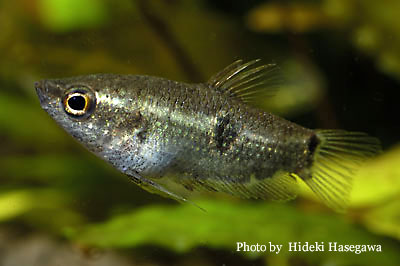
 其實就是眼斑飛船 (Parasphaerichthys ocellatus) (=Sphaerichthys ocellatus). 不常進口的可愛小型口孵型迷鰓魚, 對於這類極端害羞又敏感的魚來說, 把牠們養在水草濃密的單種飼養缸大概是最好的辦法, 其實幾種小型飛船還有印度火箭這類的魚大概都有這樣的問題, 因為太害羞了, 所以混養性不高, 再加上對同種個體的攻擊性高(如韋蘭提飛船), 所以若要飼養數對以上的個體, 最好使用大一點的水族箱, 要不然就是比照短鯛的規格一對單缸飼養, 有關飼養的注意事項可參考此處的說明, 其繁殖行為可參考Ralf Britz等人於1995年發表於Japanese Journal of Ichthyology的文章.魚隻來源: 石頭水族 (台北)
圖片連結: allabout.co.jp
 文獻來源: Wu Y, Rovito SM, Papenfuss TJ, Hanken J. 2009. A new species of the genus Paramesotriton (Caudata: Salamandridae) from Guangxi Zhuang Autonomous Region, southern China. Zootaxa 2060: 59-68. Abstract A new species of Asian warty newt, Paramesotriton ermizhaoi, is described from Guangxi Zhuang Autonomous Region in southern China. This species is easily distinguished from other congeners by external morphology and osteology. Phylogenetic analyses based on mitochondrial data place P. ermizhaoi as a possible sister taxon to P. hongkongensis and P. chinensis. The number of trunk vertebrae varies from 12 to 13 in the new species. The relationship between P. ermizhaoi and a potentially new Pachytriton species (Pachytriton C), and the Guangxi population of P. chinensis is briefly discussed.
 文獻來源: Arnold EN. 2009. Relationships, evolution and biogeography of Semaphore geckos, Pristurus (Squamata, Sphaerodactylidae) based on morphology. Zootaxa 2060: 1-21.
Abstract
The Sphaerodactylid gecko genus Pristurus has at least 20 recognised species in Arabia, the Socotra archipelago, and northeast Africa with an isolate 4500km away in Mauritania. Analysis of nineteen variable morphological characters in the Sphaerodactylidae suggests Pristurus is most closely related to Quedenfeldtia of Morocco and then successively to the Spaerodactylini and Saurodactylus. This contrasts with recent studies using nuclear DNA, which place Pristurus in a basal polychotomy in the family. If the molecular tree is correct, there must have been considerable parallelism in anatomy in these taxa. Within Pristurus, parsimony analysis was carried out on a set of 72 variable morphological characters (equivalent to 86 binary ones) from external features, skeleton, musculature and behaviour. Apparent relationships are as follows: P. celerrimus (P. insignis, P. insignoides) (P. guichardi (P. socotranus (P. abdelkuri (P. rupestris, P. popovi, P. flavipunctatus, P. gallagheri, P. adrarensis, the Spatalura clade)))). Relationships within the Spatalura clade are: (P. minimus, P. simonettai) (P. crucifer, P. phillipsi (P. somalicus (P. saada (P. collaris (P. ornithocephalus, P. carteri))))). The more basal Pristurus were apparently primitively heliothermic rock climbers with one lineage becoming tree dwelling. These forms are now confined to the North Oman mountains of eastern Arabia and the Socotra archipelago and may have been replaced elsewhere in Arabia and perhaps northern Africa by a radiation of more morphologically advanced species. Most of these have similar niches to the more primitive forms, but one lineage that gave rise to the Spatalura clade became ground dwelling and partly nocturnal. Many morphological changes on the phylogeny of Pristurus may be functionally associated with shifts in ecology and behaviour.
圖片連結: どうぶつ共和国WOMA

 文獻來源: Brown JL, Morales V, Summers K. 2009. Tactical reproductive parasitism via larval cannibalism in Peruvian poison frogs. Biology Letters 5(2): 148-151. doi: 10.1098/rsbl.2008.0591