 Melanochelys trijuga thermalis 斯里蘭卡黑山龜 x 1

2010年3月2日 星期二
2010年3月1日 星期一
2010-03-01新進魚隻
 Corydoras sp. cf. arcuatus (Brazil?) 皇冠印弟安鼠 (可以比較一下和"秘魯皇冠印第安鼠"是差在那裏) x 10
Hemitheconyx caudicinctus 肥尾守宮 x 2
魚隻來源: 悠遊魚坊


2010年2月27日 星期六
2010-02-27新進魚隻
Phenacogrammus altus 歐斯得月球燈 x 5
Boraras ? 彩虹小丑燈 x 13 (含雜燈)
Belontia signata 斯里蘭卡梳尾魚 x 2
魚隻來源: 水世界, 台族水族, 某蝦米大大
Boraras ? 彩虹小丑燈 x 13 (含雜燈)
Belontia signata 斯里蘭卡梳尾魚 x 2
魚隻來源: 水世界, 台族水族, 某蝦米大大
2010年2月26日 星期五
2010年2月25日 星期四
2010-02-25新進魚隻
 Corydoras melini 紅斜紋鼠 x 2 (不要笑, 幾乎沒買過耶)
Corydoras loxozonus 黑箭斜紋鼠 x 2 (理由同上)
Corydoras gracilis 迷你鼠 x 10 (人好所以收容)
Corydoras sp. cf. arcuatus 秘魯產印弟安鼠 ??? x 2 (名字很威, 但看不出差在那裏)
Danio dangila 長鬚斑馬 x 4
Rasbora spp. 不會分的小波魚 x 若干
魚隻來源: 哲園水族, 澤苑珍魚館, 方舟水族
2010年2月24日 星期三

2010年2月23日 星期二
2010-02-23新進動物與魚隻
 Hemitheconyx caudicinctus 直線肥尾守宮 x 1
Sternarchorhynchus roseni 象鼻飛刀 x 3 (參看這邊與這邊的說明)
Nandus nandus 印度枯葉虎 x 3
Melanotaenia parkinsoni 帕金森美人 x 7
魚隻來源: 永信水族(華夏店)
2010年2月21日 星期日
野生地鼠陸龜因草酸引發腎衰竭致死案例
文獻來源: Jacobson ER, Berry KH, Stacy B, Huzella LM, Kalasinsky VF, Fleetwood ML, Mense MG. 2009. Oxalosis in wild desert tortoises, Gopherus agassizii. Journal of Wildlife Diseases 45(4): 982-988.
Abstract
We necropsied a moribund, wild adult male desert tortoise (Gopherus agassizii) with clinical signs of respiratory disease and elevated plasma biochemical analytes indicative of renal disease (blood urea nitrogen [415 mg/dl], uric acid [11.8 mg/dl], sodium [>180 mmol/l] and chloride [139 mmol/l]). Moderate numbers of birefringent oxalate crystals, based on infrared and electron microscopy, were present within renal tubules; small numbers were seen in colloid within thyroid follicles. A retrospective analysis of 66 additional cases of wild desert tortoises was conducted to determine whether similar crystals were present in thyroid and kidney. The tortoises, from the Mojave and Sonoran deserts, were necropsied between 1992 and 2003 and included juveniles and adults. Tortoises were classified as healthy (those that died due to trauma and where no disease was identified after necropsy and evaluation by standard laboratory tests used for other tortoises) or not healthy (having one or more diseases or lesions). For all 67 necropsied tortoises, small numbers of crystals of similar appearance were present in thyroid glands from 44 of 54 cases (81%) and in kidneys from three of 65 cases (5%). Presence of oxalates did not differ significantly between healthy and unhealthy tortoises, between age classes, or between desert region, and their presence was considered an incidental finding. Small numbers of oxalate crystals seen within the kidney of two additional tortoises also were considered an incidental finding. Although the source of the calcium oxalate could not be determined, desert tortoises are herbivores, and a plant origin seems most likely. Studies are needed to evaluate the oxalate content of plants consumed by desert tortoises, and particularly those in the area where the tortoise in renal failure was found.
2010年2月20日 星期六
2010-02-20新進動物與魚隻


 Terrapene ornata luteola 沙漠錦箱龜 x 2
Corydoras sp. "naoki" (=C092) or mususu longnose (???) 長吻一線帝王鼠(???) (長吻納奇鼠) x 7
Corydoras evelynae "Peru" Type I x 3
Corydoras evelynae "Peru" Type II x 3
Corydoras evelynae "Peru" Type III x 1
Trichopodus cantoris 蛇皮馬甲 x 3
Ageneiosus sp. cf. piperatus 玻璃虎鯨 x 20
Ichthyborus ornatus 紅木紋飛鳳火箭 x 7
Malpulutta kretseri 潘安鬥魚 x 6 (據說是什麼紅型) (見此討論)
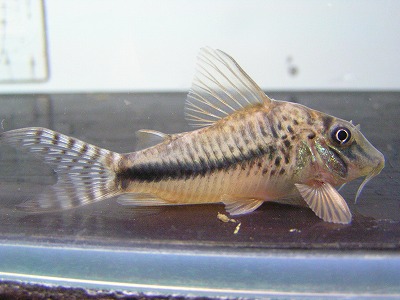
Corydoras evelynae實在是很妙的魚. 它的模式產地在巴西, 但是哥倫比亞及秘魯都能出口, 所以倒底是這條魚(或這群魚)分布廣泛? 還是各地的煙圈鼠的各型都是當地鼠魚經由先然雜交產生的產物? 至於那些長得很像naoki的魚可參考先前2009-10-05的討論. 這次進口的"naoki"與2008年進口的那批魚是有一點點不太一樣. 這次進口的魚在胸部出現了類似acutus的細點, 而不是過去那批naoki的粗斑點. 但是已知的相似物種分布在秘魯境內的除了naoki還有所謂的"Corydoras sp. Mususu longnose"和"Corydoras sp. Sazan Kuros super"(コリドラス スーパーサザンクロス), 所以情況倒底是怎樣, 我不太清楚耶. naoki是一條與C91與斑鰭鼠共棲的魚, 但C91在近年已經被好事的日本人分成好幾個型, 這些型是否暗示著任何地理分化我還不清楚, 但如果這次進口的naoki真的是秘魯來的, 有沒有一個可能, 就是naoki (=C92)與C91在不同的河段的斑紋具有趨同的現象呢? 然後這樣的分化就形成了所謂naoki, Mususu longnose或Sazan Kuros呢? 這次進口的魚, 讓我東想西想後, 我會傾向於先把它當成Corydoras Mususu longnose, 因為它仍然缺乏一般naoki所具備的三個特徵: (1) 吻部與鰓蓋的黑斑; (2) 側線黑線到尾柄部加粗; (3) 胸部黑斑集中, 並非細點分散. 以下是幾個網頁所具有的"naoki"影象:
- www.aquashopping.net (標示為長吻秘魯邦迪鼠)
- FC2 Blog (標示為長吻秘魯邦迪鼠或naoki)
- 同樣是FC2 Blog (標示為naoki, 但與石頭水族這次進口的一模一樣)
- www.fish-pet.net (標示與上同)
- www.tsukimido.net (標示為"細紋naoki", 實魚與石頭水族這次進口的一樣)
- www.ginsui.co.jp (一般認為的naoki, 胸部雜點少且大, 側線黑線上下雜斑也少)
- Remix (同上)
- I Love Corydoras (基本上這個網頁把naoki和Peru bondi longnose當成同一個物種)
註二: 那個Sazan Kuros搞半天是"Southern Cross"的日文發音, 意指"南十字星", 但有人認為Mususu LN與Southern Cross是一樣的魚
魚隻來源: 華洋水族, 石頭水族 & APT
2010年2月19日 星期五
2010-02-19新進魚隻
 Bagrichthys macracanthus 一線駱駝 x 2 (學名問題看這邊)
Corydoras sp. C121 皇冠紅頭鼠 x 1
Corydoras loxozonas 黑箭斜紋鼠 x 3 (體色介於"deckeri"與loxozonas的型)
只是順道一提, 目前根據我們的分子證據, loxozonas, axelrodi (英哥鼠, 黃金英哥鼠, 二線英哥鼠), 噴點英哥鼠, "deckeri"迪克英哥鼠, 哥倫比亞煙圈鼠(C90), 甚至是面具鼠(metae)與紅斜紋鼠(melini)間可能存在有複雜的天然雜交現象.....[參考這邊的說明]
魚隻來源: 永信水族(屏東店)
Corydoras loxozonas 黑箭斜紋鼠 x 3 (體色介於"deckeri"與loxozonas的型)
只是順道一提, 目前根據我們的分子證據, loxozonas, axelrodi (英哥鼠, 黃金英哥鼠, 二線英哥鼠), 噴點英哥鼠, "deckeri"迪克英哥鼠, 哥倫比亞煙圈鼠(C90), 甚至是面具鼠(metae)與紅斜紋鼠(melini)間可能存在有複雜的天然雜交現象.....[參考這邊的說明]
魚隻來源: 永信水族(屏東店)
[買到品質優良的耗材為何像追求真愛般困難]我的水妖精為什麼又塞住啦?


 我們有很多小缸只使用這種兩個1/4圓柱的水妖精, 因為這型的水妖精的綿可以貼壁, 對某些懸浮的髒東西有很好的吸附效果, 而且不若一般圓型水妖精那麼佔空間或擾動水面(對於需要築泡巢的魚種來說), 但是這型的水妖精最大的問題就是動不動不出水了, 沒氣了. 追根究柢就是品質不良, 除了先前我所提過的, 海綿的孔隙太細(不同批不一樣呢)會導致髒東西卡在表層使海綿失去作用, 就是連通部份的孔道設計不良: (1) 透明的出氣管太長阻斷底部通氣; (2) 通氣孔的施作品質很差, 所以一點點髒東西就可以使那邊塞住完全出不了水. 所以囉, 我們現在就只好在出氣管與通氣孔做一點改善, 以免幾乎天天都會遇上水妖精不出水的大冏......
食鳥蛛科Lyrognathus屬(馬來西亞粗腿, 印度赤灰)之系統分類研究發掘了婆羅洲產L. fuscus, L. achilles與龍目島產L. lessunda三個新種, 而L. saltator需被重新描述

 文獻來源: West RC, Nunn SC. 2010. A taxonomic revision of the tarantula spider genus Lyrognathus Pocock, 1895 (Araneae, Theraphosidae), with notes on the Selenocosmiinae. Zootaxa 2362: 1-43. [摘要連結]
Abstract
The tarantula genus Lyrognathus Pocock 1895 is revised with three new species described: L. achilles sp. nov. from Gunung Nibung, Borneo; L. fuscus sp. nov. from Simpang Kubur, Borneo and L. lessunda sp. nov. from Lombok Island, Indonesia. The male of L. robustus Smith 1988 is described for the first time, the female is redescribed. L. crotalus Pocock 1895 is considered a senior synonym of L. pugnax Pocock 1900. Several new characters are discussed, with Lyrognathus keyed to species. The diagnosis of the Selenocosmiinae is amended. Zoogeographic distribution, natural history and subfamilial relationships with proposed sister genera Selenocosmia Ausserer 1871 and Coremiocnemis Simon 1892 are discussed. Lyrognathus saltator is redescribed. Selenocosmia lyra Strand 1913 is considered a nomen dubium.
2010年2月17日 星期三
2010-02-17新進魚隻
Corydoras sp. cf. blochi "Manaus" 灰甲鼠 x 3 (請參考cainx大大的文章)
Planiloricaria cryptodon 圓鍬直升機 x 2
魚隻來源: 永信水族(華夏店)
Planiloricaria cryptodon 圓鍬直升機 x 2
魚隻來源: 永信水族(華夏店)
2010年2月16日 星期二
中國雲南產副鰍屬新種南盤江副鰍的記述
文獻來源: Min, R., Chen, X. & Yang, J. (2010): Paracobitis nanpanjiangensis, a new loach (Balitoridae: Nemacheilinae) from Yunnan, China. Environmental Biology of Fishes, DOI: 10.1007/s10641-010-9587-z (online pre-publication)
Abstract
A new species of the genus Paracobitis, Paracobitis nanpanjiangensis is described from tributaries of the Nanpanjiang River drainage in China. It is distinguished from its congeners, except P. oligolepis and P. wujiangensis, by body scaleless or with rudimentary scales (caudal peduncle with several deeply embedded scales). It can be differentiated from P. wujiangensis by the complete lateral line (vs. incomplete), lower dorsal crest reaching the vertical of origin of anal fin (vs. shorter and higher dorsal crest not reaching the base of anal fin). It is distinguished from P. oligolepis by the following characters: branched dorsal fin with 81/2 (a few 91/2) rays (vs. 91/2), interspaces between bars in front of dorsal fin conspicuously thinner than those behind (vs. vermiform markings), dorsal head without vermiform markings or obscure (vs. clearly vermiform markings on dorsal head), vertebrae 4 + 36–38 (vs. 4 + 39–41).

2010年2月15日 星期一
一妻多夫制的黑間鳳凰(Julidochromis transcriptus)雌性馭夫有術: 利用三角型的楔形產卵空間使體型不同的雄性皆可為卵授精, 各自照顧北鼻, 而且不會靠夭吵架

文獻來源: Kohda M, Heg D, Makino Y, Takeyama T, Shibata J-Y, Watanabe K, Munehara H, Hori M, Awata S. 2009. Living on the wedge: female control of paternity in a cooperatively polyandrous cichlid. Proceedings of the Royal Society B 276(1676): 4207-4214. [link]
Abstract
Theories suggest that, in cooperatively breeding species, female control over paternity and reproductive output may affect male reproductive skew and group stability. Female paternity control may come about through cryptic female choice or female reproductive behaviour, but experimental studies are scarce. Here, we show a new form of female paternity control in a cooperatively polyandrous cichlid fish (Julidochromis transcriptus), in which females prefer wedge-shaped nesting sites. Wedge-shaped sites allowed females to manipulate the siring success of the group member males by spawning the clutch at the spot where the large males were just able to enter and fertilize the outer part of the clutch. Small males fertilized the inner part of the clutch, protected from the large aggressive males, leading to low male reproductive skew. Small males provided more brood care than large males. Multiple paternity induced both males to provide brood care and reduced female brood care accordingly. This is, to our knowledge, the first documented case in a species with external fertilization showing female mating behaviour leading to multiple male paternity and increased male brood care as a result.
馬達加斯加刺尾鬣蜥利用共棲之馬達加斯加授帶鳥對其共同天敵的警示鳴唱作為警戒訊息





 [superlink: wikipedia, photo credit: flickr user Belgianchocolate]

文獻來源: Ito R, Mori A. 2010. Vigilance against predators induced by eavesdropping on heterospecific alarm calls in a non-vocal lizard Oplurus cuvieri cuvieri (Reptilia: Iguania). Proc. R. Soc. B published online before print December 23, 2009, doi:10.1098/rspb.2009.2047
Abstract
Prey animals can reduce their risk of predation by detecting potential predators before encounters occur. Some animals gain information about nearby predators by eavesdropping on heterospecific alarm calls. Despite having well-developed ears, most lizards do not use vocal information for intraspecific communication, and few studies have shown practical use of the ears in wild lizards. Here, we show that the Madagascan spiny-tailed iguana (Oplurus cuvieri cuvieri) obtains auditory signals for predator detection. The Madagascan spiny-tailed iguana and the Madagascar paradise flycatcher (Terpsiphone mutata) are syntopic inhabitants of the Ampijoroa dry deciduous forest of Madagascar. The iguana and the flycatcher have neither a predator–prey relationship nor resource competition, but they have shared predators such as raptors and snakes. Using playback experiments, we demonstrated that the iguana discriminates mobbing alarm calls of the flycatcher from its songs and then enhances its vigilance behaviour. Our results demonstrate the occurrence of an asymmetrical ecological relationship between the Madagascan spiny-tailed iguana and the paradise flycatcher through eavesdropping on information about the presence of predators. This implies that indirect interspecific interactions through information recognition may be more common than generally thought in an animal community.
2010年2月14日 星期日
瞭解華人消費動機才能有效掌控對野生動物資源的非永續利用
 Understanding Chinese consumer motivation the key to controlling unsustainable wildlife consumption
A survey of consumer attitudes in China concluded urgent action is needed to reduce consumer demand for endangered wildlife Click photo to enlarge China, Beijing, 28 January 2010—Concerted action is needed in China to reduce consumer demand for endangered wildlife, according to a new report by TRAFFIC, wildlife trade monitoring network, into consumer attitudes in China.
Released ahead of Chinese New Year of the Tiger, which begins on 14 February, the report, Understanding the motivations: the first step toward influencing China’s unsustainable wildlife consumption, calls for a reduction in wildlife consumption during the New Year celebrations, normally the peak time for wildlife consumption in the country...[詳全文與完全報告pdf檔下載]
使用四個基因序列重建脂鯉目的親緣關係不支持多數大屬(如Astyana, Hyphessobrycon, Bryconamericus, Hemigrammus)的單系性, 而銀大眼脂鯉亞科(銀銅燈)應僅限用於該屬
文獻來源: Javonillo R, Malabarba LR, Weitzman SH, Burns JR. 2010. Relationships among major lineages of characid fishes (Teleostei: Ostariophysi: Characiformes), based on molecular sequence data, Molecular Phylogenetics and Evolution, 54(2): 498-511.
Abstract
The family Characidae is a group of freshwater bony fishes that exhibits high species-level diversity and whose members inhabit parts of Texas, Mexico, and Central and South America. Thus far, morphological data have been of limited use in discerning relationships among subfamilies and incertae sedis genera of the family Characidae. In this study, DNA sequence data from GenBank were combined with new sequences for analyses under Bayesian and parsimony schemes. Sequences fell into four gene partitions, with three genes in the mitochondrial subset (12S, 16S, COI genes) and one gene in the nuclear subset (RAG2 gene). Inferred Bayesian and parsimony-based phylogenies reject the monophyly of certain groups (e.g., Astyanax, Hyphessobrycon, and Bryconamericus), do not reject the monophyly of others (e.g., Cheirodontinae and 'clade A' of previous authors), and present new sister-group hypotheses (e.g., Brittanichthys sister to Paracheirodon). Sister to clade A is a lineage referred to herein as 'clade B' which includes Exodon and exemplars from Cheirodontinae (the most basal lineage within clade B), Aphyocharacinae, Tetragonopterinae, and Characinae (excluding Gnathocharax). 'Clade C' is sister to A + B and contains representatives of large incertae sedis genera (e.g., Hyphessobrycon, Hemigrammus), as well as members of Stethaprioninae. Unless certain other subfamilial names are to be disregarded, the use of Tetragonopterinae should continue to be restricted to species of Tetragonopterus because other genera previously referred to this subfamily grouped in clades A or C, quite distant from Tetragonopterus.
隱孢子蟲症(Cryptosporidiosis)導致四趾陸龜與餅乾龜死亡的案例
文獻來源: Griffin C, Reavill DR, Stacy BA, Childress AL, Wellehan Jr JFX. 2010. Cryptosporidiosis Caused By Two Distinct Species In Russian Tortoises And A Pancake Tortoise, Veterinary Parasitology, In Press
Abstract
Cryptosporidiosis in squamates is well documented, but there is very limited information available on cryptosporidiosis in testudines. We describe three cases of cryptosporidiosis in tortoises with associated pathology. Two Russian tortoises (Agrionemys [Testudo] horsfieldii) and a pancake tortoise (Malacochersus tornieri), all from separate collections, were found dead. At necropsy, two had histological evidence of intestinal cryptosporidiosis and one had gastric cryptosporidiosis. Consensus Cryptosporidium sp. PCR and sequencing was used to identify the Cryptosporidium sp. present in these three tortoises. In the juvenile Russian tortoise with gastric cryptosporidiosis, the organism had 98% homology with a previously reported sequence from an Indian star tortoise isolate. A second chelonian Cryptosporidium sp. was identified in the pancake tortoise and the second Russian tortoise. This sequence was 100% identical to a shorter gene sequence previously reported in a marginated tortoise. This is the first report coordinating pathology with Cryptosporidium characterization in chelonians. The two Cryptosporidium sp. found in tortoises segregate according to site of infection, and there may be further differences in pathology, host range, and transmission. These Cryptosporidium sp. appear to be able to infect diverse tortoise host species. This may be an under-recognized problem in tortoises.
訂閱:
文章 (Atom)