顯示具有 Gekkonidae 標籤的文章。 顯示所有文章

2011年12月31日 星期六

2011-12-29 新進動物與魚隻

Corydoras imitator 長吻紅頭鼠 x 3
Characidae sp. 雜燈數種 x 若干
Hydromedusa tectifera 釘頸龜 x 2


2011年11月28日 星期一

2011-11-28新進動物與魚隻

Corydoras serratus 薩瑞塔鼠 x 2
Corydoras sp. New Victoria (=C. sp. C129) 新維多利亞鼠 x 4
Zephronia sp. 雲頂高原球馬陸 x 6 (還有3D動畫版)
Acanthosaurus armata 長棘蜥 x 4
Cyrtodactylus pulchellus 檳城弓趾虎(馬來西亞森林守宮, 橫帶守宮) x 2
Cyrtodactylus sp. cf. peguense 類似庇古細趾守宮的東東 x 1
Cyrtodactylus sp. cf. elok 某某虎 x 4
Aeluroscalabotes felinus 貓守宮 x 4

魚隻來源: 永信水族(華夏店)
攝影: 陳猴啾

2011年1月7日 星期五

2011-01-07新進動物與魚隻

Phelsuma grandis 巨型日守宮(不是P. madagascariensis) x 2
Hydromedusa tectifera 釘頸龜 x 2 (不是Acanthochelys spixii刺頸龜)
Kinixys spekii 莽原折背龜 x 2
Corydoras imitator 長吻紅頭鼠(不是C. crypticus皇冠黑背鼠) x 10
Corydoras sp. cf. aeneus 野生咖啡鼠 x 5
Corydoras osteocarus 黃花鼠 x 20 (以黑箭米老鼠C. armatus或米老鼠C. loretoensis名義輸入的極少見物種)
Paedocypris progenetica 精靈露比燈(壤鯉) x 20

魚隻來源: 民族水族

2010年8月19日 星期四

2010-08-19新進魚隻與動物

Orthriophis taeniurus ridleyi (=Elaphe taeniata ridleyi) 洞穴黑眉錦蛇 x 5
Gekko monarchus 脊斑守宮 x 7
Rhinomugil corsula 吻鯔 (=印度四眼魚) x 27
Mastacembelus sp. 坦干依喀鰻(學名待討論) x 4
Leptodoras? sp. 尖咀藍海豚鐵甲武士 x 2
Dianema longibarbis 長吻戰車鼠 x 4
Corydoras sp. C140 Highfin 長吻皇冠紅頭鼠 x 5
Betta rubra 璐伯拉鬥魚 x 1對
Neolebias trilineatus 三線短筆燈 x 10
Hyphessobrycon takasei 小丑旗 x 5
Odontocharacidium aphanes 神秘牙脂鯉(紅蓮跳鱸) x 10
Devario sp. cf. malabaricus 金帶斑馬 x 6 (這應該是緬甸產的魚, 可與印度產的大斑馬malabaricus作比較)
Kottelatia brittani 桔點燈 (=金腹燈) x 10
Rasbora sp. cf. elegans 火翅精靈燈中的雜燈 x 33

[再說, 好忙喔] 這次我想要討論的梗是: (1) 東非大地塹地帶所產的棘鰍的鑑定 (2) 這次輸入的C140背鰭很高的問題 (3) 還有Hyphessobrycon屬中的食鰭行為.

魚隻來源: 民族水族, 民權水族

2010年5月9日 星期日

2010-05-09新進動物

Goniurosaurus luii 中華豹紋守宮/中國豹紋守宮/中華瞼虎/凭祥瞼虎 x 9 (參看Grismer et al. (1999)的原始文獻)
Geoemyda spengleri 黑胸葉龜 x 10

2010年4月30日 星期五

2010-04-30新進動物與魚隻

Bronchocela jubata 綠角蜥 x 7
Gonocephalus chamaeleontinus 爪哇冠蜥 x 5
Gehyra marginata (Vanuatu morph) 萬納杜產裂足虎 (=太平洋巨人守宮) x 1 (說明)
Tarentola mauritanica 鱷魚守宮 x 1
Gekko vittatus Y字守宮(白紋守宮) x 6
Salamandra salamandra terrestris 法國火蠑螈 x 2
Damon variegatus 坦尚尼亞無尾鞭蠍 x 8
Cyclocosmia ricketti 中國活板門蜘蛛 (=芮氏盤腹蛛) x 8
Enneacampus ansorgii 藍星海龍 x 4
Hyphessobrycon metae 梅塔黑霓虹 x 若干
Phyllonemus typus 長鬚緞帶貓 (=剃刀鯰, 泰普斯鬍鬚鯰) x 2
Corydoras reynoldsi 雷諾鼠 x 4
Serpenticobitis octozona (???) 八帶蛇鰍(=墨斑鰍) x 5

我們終於開始處理非昆蟲的陸生無脊椎動物了. 已經被寵物化的陸生無脊椎動物不外乎蛛形綱, 倍足綱與唇足綱的生物. 而蛛形綱的生物中除了食鳥蛛, 蠍子, 避日蛛(Solifugae)之外, 就剩下鞭蠍(Thelyphonida)以及無尾鞭蠍(或有人稱無尾鞭蛛)(Amblypygi)了. 我還沒弄清楚在全球的寵物市場上有多少種無尾鞭蠍, 不過先看看台灣產的無尾鞭蠍.台灣產的無尾鞭蠍似乎是一些自然攝影大大到蘭嶼拍東拍西的基本款(或伴手禮?). 但台灣產的無尾鞭蠍是那一種? 高島春雄於1947年所發表的"南方諸地域に於ける脚髪目概説", "南方諸地域の蜴概説"以及1950年發表的"Notes on Amblypygi found in territories adjacent to Japan"指出, 產於蘭嶼的無尾鞭蠍是Charon grayi (Gervais, 1844)(註一). 這個觀點至少到目前為止沒有被推翻過. 但我在網路上看到有大大說, 台灣還有另一種無尾鞭蠍叫Phrynichus orientalis, 但是我卻找不到任何文獻證據指出台灣有這個種. 連Mark S Harvey在2003年出版的大作Catalogue of the Smaller Arachnid Orders of the World Amblypygi, Uropygi, Schizomida, Palpigradi, Ricinulei and Solifugae (google預覽)也沒提到台灣有這個種, 如果有人知道Phrynichus在台灣的記錄是那來的, 麻煩跟我指點一下. 好吧, 台灣的Charon和進口的Damon在外型上差不了多少, 但是在無尾鞭蠍目的分類系統中是分屬不同總科的生物. 然而拿來當寵物的非洲產"無尾鞭蠍"都是variegatus嗎? 先看一下Prendini et al. (2005)這篇文章, 再看看在台灣市面上流通的物種是那一個. 順道一提的是, 鞭蠍目的姐妹群裂盾蠍目(或稱短尾鞭蠍目)(Schizomida)在台灣應該有幾個物種的分布, 但是甚少在台灣的論壇上被討論.

阿那個盤腹蛛看起來真的很欠打, 國外已經有一些論壇討論飼養與繁殖(看這邊這邊), 至於鑑定正不正確呢? 可以參考Zhu et al. (2006)的這篇論文, 上面有清楚的繪圖.

註一: 但很奇怪的是, 有些台灣網頁把台灣產無尾鞭蠍學名的作者與年代誤植為"Thorell, 1888", 但Thorell並不是grayi這個種的作者, 而是Charon其它分類群如papuanus的作者.

魚隻來源: 華洋水族
圖片拍攝: 蟲之友

2010年4月8日 星期四

2010-04-08新進動物

Goniurosaurus lichtenfelderi 越南洞穴守宮 x 14 (有人說海南洞穴守宮hainanensis尾部無橫紋, 我認為那是因為他看到的是斷尾後再生個體的關係)

好的, 那麼"中國洞穴守宮"倒底是什麼? 我認為這些名稱與實際上所看到的動物的應對已經混亂很久了. 首先, Goniurosaurus絕對不像一般寵物網頁上說的只有5-6種, wiki上比較新的整理列舉了11種(但是wiki這個整理並不算是太好, 並沒有把重要的文獻都列出來). 根據wiki上的整理, 與中國/越南相關的物種如下, 中名則是各方找來的:
  • Goniurosaurus araneus – Vietnamese Leopard Gecko - 越南豹紋守宮/中國虎紋守宮/蛛瞼虎
  • Goniurosaurus bawanglingensis - 霸王嶺瞼虎
  • Goniurosaurus catbaensis Ziegler, Truong, Schmitz, Stenke & Rösler, 2008 - 吉婆島瞼虎
  • Goniurosaurus luii – Chinese Cave Gecko - 中華豹紋守宮/中國豹紋守宮/中華瞼虎/凭祥瞼虎
  • Goniurosaurus hainanensis – Hainan Leopard Gecko - 海南瞼虎/海南洞穴守宮/中國洞穴守宮
  • Goniurosaurus lichtenfelderi – Lichtenfelder's Gecko - 瞼虎/越南洞穴守宮
看起來名字很亂吧? 現在有兩個問題: (1) "中國洞穴守宮"這個名稱似乎是台灣叫出來的, 但是台灣人所稱呼的中國洞穴守宮倒底是那一種呢? lichtenfelderi或hainanensis? (2) 多數相關學者都同意hainanensis和lichtenfelderi實在是非常難分(據說只有什麼眼瞼鱗片數的差別), 再加上我們根本無法得知在台灣市場上流通的Goniurosaurus是那裏採來的, 所以說這個"中國洞穴守宮"一詞可能只能拿來泛指"中國過來的東西".

2010年3月19日 星期五

2010年3月1日 星期一

2010-03-01新進魚隻

Corydoras sp. cf. arcuatus (Brazil?) 皇冠印弟安鼠 (可以比較一下和"秘魯皇冠印第安鼠"是差在那裏) x 10
Hemitheconyx caudicinctus 肥尾守宮 x 2

魚隻來源: 悠遊魚坊

2010年2月23日 星期二

2010-02-23新進動物與魚隻

Hemitheconyx caudicinctus 直線肥尾守宮 x 1
Sternarchorhynchus roseni 象鼻飛刀 x 3 (參看這邊這邊的說明)
Nandus nandus 印度枯葉虎 x 3
Melanotaenia parkinsoni 帕金森美人 x 7

魚隻來源: 永信水族(華夏店)

2010年2月9日 星期二

印尼摩鹿加群島產裂足虎Gehyra barea的系統分類地位與新幾內亞西岸Raja Ampat島新種之描述

文獻來源: Oliver P, Sistrom M, Tjaturadi B, Krey K, Richards S. 2010. On the status and relationships of the gecko species Gehyra barea Kopstein 1926, with description of new specimens and a range extension. Zootaxa 2354: 45-55.

Abstract
Gehyra barea is a poorly known gecko species from the southern Banda Islands, Maluku Province, Indonesia, that has received scant attention since it was described in 1926. A combination of morphological characters distinguish the types of this species from all other described Gehyra, and suggest that it is a distinct taxon. These same morphological characters occur in two recently collected specimens from the Raja Ampat Islands, just off the west coast of New Guinea, that we assign to this species, extending the known range of the taxon by over six hundred kilometres. We provide a revised and extended diagnosis and description of the species based on these new specimens. Morphological and genetic data from these specimens indicate G. barea is closely related to Gehyra baliola from further east in southern New Guinea, and that these species form a clade with Geyhra oceanica. Gehyra is a taxonomically challenging group, and the status of most species from the Melanesian region is in need of review.

2010年2月8日 星期一

長腰絲絨守宮在溫度變動劇烈且天敵環伺之環境下選擇可提供恆定低溫的岩縫產卵

[superlink: wikipedia, photo credit: Hexasoft]

文獻來源: Pike DA, Webb JK, Shine R. 2010.
Nesting in a thermally challenging environment: nest-site selection in a rock-dwelling gecko, Oedura lesueurii (Reptilia: Gekkonidae). Biological Journal of the Linnean Society 99(2): 250-259.


Abstract
In egg-laying species, maternal oviposition choice can influence egg survival and offspring phenotypes. According to the maternal-preference offspring-performance hypothesis, females should choose oviposition sites that are optimal for offspring fitness. However, in thermally challenging environments, maternal oviposition behaviour may be constrained by the limited availability of suitable oviposition sites. We investigated nest-site selection in a nocturnal lizard [velvet gecko Oedura lesueurii (Duméril and Bibron)] that inhabits a thermally challenging environment in south-eastern Australia. The viability of these gecko populations is critical for the persistence of an endangered snake species (Hoplocephalus bungaroides Wagler) that feeds heavily on velvet geckos. Female geckos chose nest sites nonrandomly, with 87% of nests (N = 30) being laid in deep crevices. By contrast, only 13% of clutches were laid under rocks, which were the most readily available potential nest sites. Nest success in crevices was high (100%), but no eggs hatched from nests under rocks. Temperatures in nest crevices remained relatively low and constant throughout the incubation period (mean = 22.7 °C, range 21.0–24.5 °C), whereas thermal regimes under rocks showed large diurnal fluctuations. Geckos selected crevices that were deeper, had less canopy cover, and were warmer than most available crevices; in 85% of cases, such crevices were used simultaneously by more than one female. The thermally distinctive attributes of nest sites, and their frequent communal use, suggest that nest sites are a scarce resource for female velvet geckos, and that the shading of rock outcrops through vegetation encroachment may influence nest success in this species.

2010年2月5日 星期五

越南南部金甌省產東虎屬一新種 - Cnemaspis psychedelica

[photo provided by Dr. Ngo Van Tri]
文獻來源: Grismer LL, Ngo VT, Drismer JL. 2010. A colorful new species of insular rock gecko (Cnemaspis Strauch 1887) from southern Vietnam. Zootaxa 2352: 46-58.

Abstract
A new species of endemic, insular Cnemaspis is described from Hon Khoai Island, Ca Mau Province, Ngoc Hien District, 18 km off the southern tip of the Ca Mu Peninsula in southern Vietnam. Cnemaspis psychedelica sp. nov. is the most uniquely colored of all southeast Asian Cnemaspis in that both sexes and all age classes have bright orange forelimbs, forelegs, hands and feet; a bright orange tail; a dense, yellow reticulum on the neck overlying thick, black, longitudinal lines; and a blue-gray to light purple trunk bearing yellow transverse bars on bright-orange flanks. It also differs from all other species of Cnemaspis in aspects of size and squamation. Cnemaspis psychedelica is the third insular endemic species of Cnemaspis from Vietnam and brings the total number of species in Vietnam to six. Its occurrence on one of the 92 islands in Rach Gia Bay underscores the necessity for continued surveys of these poorly known islands that are beginning to show a surprising degree of endemism and diversity.

2010年1月28日 星期四

越南南部平順省產守宮屬一新種, Gekko laurenti

[Image reproduced with permission from Dr. Ngo Van Tri]
文獻來源: Ngo VT, Gamble T. 2010. A new species of Gekko (Squamata: Gekkonidae) from Tà Kóu Nature Reserve, Binh Thuan Province, Southern Vietnam. Zootaxa 2346: 17-28.

Abstract
A new species of Gekko Laurenti is described from Tà Kóu Mountain, an isolated granitic peak in Tà Kóu Nature Reserve, Ham Thuan Nam district, Binh Thuan province, southern Vietnam. The species is distinguished from its congeners by its moderate size, with snout to vent length (SVL) reaching a maximum 107.0 mm; dorsal pattern of 5–8 white vertebral blotches between the nape and sacrum and 6–8 pairs of short white bars on the flanks; 11–14 precloacal pores in males; 14–17 longitudinal rows of smooth dorsal tubercles; and 18–20 broad lamellae beneath the fourth toe. Gekko takouensis sp. nov. is the second endemic gekkonid discovered in the Tà Kóu Nature Reserve, Cyrtodactylus takouensis Ngo & Bauer being the first.

2010年1月17日 星期日

西藏尼木縣(涅莫)產裸趾虎新種 - 趙氏裸趾虎 Cyrtodactylus zhaoermii

文獻來源: Shih L, Zhao H. 2010. A new species of Cyrtodactylus (Reptilia: Squamata: Geckkonidae) from Xizang Autonomous Region, China. Zootaxa 2336: 51-60.

Abstract
A new species of Cyrtodactylus described from Nyemo County, Xizang Autonomous Region, China is here referred to a new species, Cyrtodactylus zhaoermii sp. nov. It is distinguished from all other Cyrtodactylus by the following characters: dorsal surface of the body with fine granules intermixed with larger sub-conical tubercles arranged into 20 more or less regular rows; proximal subdigital lamellae transversely expanded; 19–20 subdigital lamellae on toe IV; 30–32 midbody ventral scales; most scales in femoral region small, granular, series of 12–14 enlarged femoral scales lacking pores; a series of precloacal pores (4) present in male; tail with distinct segments, large, posteriorly directed tubercles in whorls, numbering nine to ten per caudal annulus, three on each side and three to four on the dorsum, situated at the posterior edge of each annulus; subcaudals not transversely expanded. The new species is the fourth Cyrtodactylus known from Xizang Autonomous Region.

2010年1月7日 星期四

Gekko canhi - 一種產於越南北部之守宮新種

文獻來源: RÖSLER H, NGUYEN TQ, DOAN KV, HO CT, NGUYEN TT, ZIEGLER T. 2010. A new species of the genus Gekko Laurenti (Squamata: Sauria: Gekkonidae) from Vietnam with remarks on G. japonicus (Schlegel). Zootaxa 2329: 56-68.

Abstract
We describe a new species of the gekkonid genus Gekko from northern Vietnam on the basis of four specimens from Lang Son and Lao Cai provinces. Gekko canhi sp. n. is distinguished from the remaining congeners by the combination of the following characters: body size moderate (SVL < 100 mm); supralabials 12–14, infralabials 10–13; nares in contact with rostral, internasal single, nasals 3; interorbitals 47–50; dorsal tubercle rows 10–13; scales between mental and cloacal slit 205–229; midbody scales 164–170; subdigital lamellae below first toe 13–16, below fourth toe 14–17; extensive webbing between fingers and toes minimal; tibial tubercles present; precloacal pores 5; postcloacal tubercles 2–3; tail round, not thickened at base; caudal tubercles present; subcaudals enlarged. We also provide new information on the taxonomy and distribution of G. japonicus in Vietnam.

2009年12月25日 星期五

2009-12-25新進動物與魚隻

Aeluroscalabotes felinus multituberculatus (?)
Aeluroscalabotes felinus multituberculatus 貓守宮(印尼產?)(不是那個silver eye) x 4 [The Reptile Database]
Rhinoclemmys punctularia 紅頭木紋龜 x 2 [The Reptile Database]
Melanochelys trijuga 黑山龜(亞種待鑑定) x 1 [The Reptile Database]
Botia udomritthiruji 細紋黃金鼠 x 2
Yasuhikotakia sidthimunki (=Botia sidthimunki) 棋盤鼠 (=網球鼠) x 2
Yasuhikotakia splendida (=Botia splendida) 黃尾帝王鼠(=冠尾黃金鰍) x 2
Channa sp. cf. gachua Myanmar 印第安雷龍(?) x 2
Glossolepis sp. incisus? pseudoincisus? multisquamatus? 青背紅美人(青背紅蘋果) x 2
Corydoras "new potaroensis" 帝王芝麻鼠 (新胭脂鼠) x 4
Peckoltia vittatus 維塔塔老虎 x 1
Peckoltia sp. L147 蛇紋美洲豹 x 1
Peckoltia sp. L008 斑點老虎 x 3
Panaqolus sp. LDA01 黃老虎 x 1
Leporacanthicus cf. galaxias (=L240) 黑白雙星 x 1
Leporacanthicus joselimai (=L264) 老鼠斑 x 1

[再說]

魚隻來源: 石頭水族 & APT, 北高雄水族(明誠店)

2009年12月15日 星期二

2009-12-15新進動物

Aeluroscalabotes felinus 貓守宮 x 3
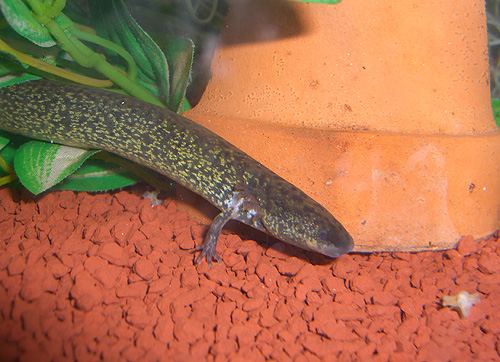
Siren lacertina 大鰻螈 x 1 (不是什麼"三趾鰻螈", 見此說明)
Lampropeltis alterna 灰帶王蛇 x 1

所謂的大鰻螈(Greater Siren)其實不大隻, 已知的記錄在47-98cm左右, 比起兩棲鯢的120cm還是小了一點. 這玩意兒有點怕熱, 所以冬天不用加溫, 但在夏天要小心水溫的升高. 我認為這類的水生有尾類不應該與任何魚混養, 一來是魚可能會吃掉牠的外鰓, 牠們也可能會吃掉魚. 不管是兩棲鯢或是鰻螈都非常容易逃脫, 因此水族箱的加蓋是有必要的. 另外有些網頁資訊把Siren張冠李戴為洞螈(Proteus anguinus), 但兩者並沒有任何直接的親緣關係.

圖片連結: Kamikaze Reptile, enzou.net

2009年12月9日 星期三

德國觀光客企圖在內衣褲中夾帶紐西蘭森林守宮等爬蟲遭到逮捕

German tried to smuggle NZ geckos, skinks in underwear
NZPA

A German visitor was caught trying to board a flight at Christchurch Airport on Sunday with endangered geckos and skinks hidden in his underwear.

Hans Kurt Kubus, a 58-year-old from Bad Munstereifel, Limbach, Germany, pleaded guilty in Christchurch District Court today to five charges of trading in exploited species, and two of hunting absolutely protected wildlife.

The court was told the geckos alone would have been worth $50,000 on the blackmarket in Europe. The value of the skinks is unknown.

Department of Conservation prosecutor Mike Bodie said all New Zealand geckos were absolutely protected under the Trade in Endangered Species Act.

He said Kubus was a German citizen who entered New Zealand at Christchurch Airport on November 15.

On Sunday he checked his luggage in at the airport and got a boarding pass to leave New Zealand.

"When searched by New Zealand Customs Service staff a small package was located concealed inside the defendant's underwear," said Mr Bodie.

"The package contained eight separate compartments separating various gecko and skink species. The defendant had hand-sewn the eight compartments together to form a single compact concealed package. The defendant's luggage also contained a single gecko in a rolled up sock."

A DOC herpetologist identified 24 geckos from five species, and 20 skinks of two species.

All the animals had been taken from the wild, contrary to the Wildlife Act.

"It was also determined that 14 our of 15 adult female geckos and 12 out of 14 female skinks in the defendant's possession were pregnant. Each pregnant animal is likely to give birth to multiple live young in the coming weeks."

"When interviewed, the defendant admitted trading geckos and taking geckos and skinks from the wild without any permit or authority and was subsequently arrested."

There was a blackmarket trade in geckos, particularly in Europe, Mr Bodie said.

"The conservative 'street' value of the geckos traded by the defendant is at least 1000 Euros per animal, or about $50,000 for 24 geckos."

The value of the skinks was unknown because this was the first time trading in skinks had been identified.

Judge Raoul Neave remanded Kubus on bail for sentencing on January 25 and asked for a pre-sentence report.