Melanophryniscus stelzneri 黃蜂蟾 (=大黃蜂蟾蜍) x 5
Amphiuma tridactylum 三趾兩棲鯢 x 2 (俗稱三趾鰻螈但牠真的不是鰻螈) (看這邊)
Siren lacertina 大鰻螈 x 2 (看這邊)
動物來源: 多彩貿易

2011年4月26日 星期二

2010年12月7日 星期二
2010-12-07新進魚隻與動物


 Betta rubra 紅色戰士鬥魚 x 3對+1
Betta smaragdina 史馬格汀那鬥魚 (以Betta sp. Mahachai 馬哈采鬥魚名義輸入) x 20
Betta simorum 賽門鬥魚 x 1對
Glossolepis ramuensis 金桔美人 x 10
Melanotaenia sp. Aru 阿魯巴美人 x 10 (這是那一型?)
Oryzias sp. Singapore 新加坡黃尾稻田魚 x 10
Rana signata 紅箭血斑蛙 x 5
Caridina serratirostris 齒顎米蝦?? (=蘇拉維西忍者蝦??? 學名似乎誤植了) x 4
Caridina "pulchella" (???) 蘇拉維西白鬚血櫻桃蝦 x 4 (這個怪學名是怎麼生出來的呢???)
Caridina spinata 蘇拉維西黃斑蝦 x 4
Faunus ater 黑蜷(=古銅鐵塔螺) x 10
- 我不知道阿魯巴美人的II型和IV型是怎麼分的, 詳情可以先閱讀Rainbowfish.info的討論
- Rana signata是一種溪流性蛙, 應該要養在具有水流的水槽中
- 馬哈采鬥魚是一個獨立種的科學根據來自Sriwattanarothai et al. (2010)發表在Journal of Fish Biology上的文章
圖片拍攝: 陳猴啾


2010年10月8日 星期五
2010-10-08新進動物與魚隻


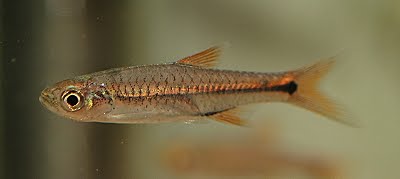


Betta macrostoma 紅戰狗 x 2對
Betta ocellata 翠綠戰狗(歐斯力特戰狗) x 4對
Betta foerschi 佛思琦鬥魚(=佛斯奇鬥魚) x 2對
Betta livida 利維達鬥魚(=麗維達鬥魚) x 2對
Rasbora sp. cf. rutteni 近似火翅精靈燈Rasbora lacrimula的未命名小波魚 x 43
Rasbora nodulosa 藍線黃尾燈 x 25
Oryzias woworae 七彩霓虹稻田魚 x 72
Pangio doriae 多里潘鰍(=迷你鰭龍) x 7
某某蝦虎 x 4 (以"Pseudogobius heyligeri"這個不存在世間的學名輸入)
Balitora burmanica 細身爬岩鰍 (=緬甸爬鰍) x 1
Gastromyzon ocellatus (?) 綠背葫蘆琵琶 x 2
Astyanax daguae 迷幻藍眼燈 x 4 (其實學名待確認)
Characidae spp. 小黑牌雜燈 x 若干
Megophrys nasuta 三角枯葉蛙 x 5
[再說, 藍戰狗翠綠戰狗傻傻不會分]
魚隻來源: 民族水族, 大龍水族, 小黑的店
Betta ocellata 翠綠戰狗(歐斯力特戰狗) x 4對
Betta foerschi 佛思琦鬥魚(=佛斯奇鬥魚) x 2對
Betta livida 利維達鬥魚(=麗維達鬥魚) x 2對
Rasbora sp. cf. rutteni 近似火翅精靈燈Rasbora lacrimula的未命名小波魚 x 43
Rasbora nodulosa 藍線黃尾燈 x 25
Oryzias woworae 七彩霓虹稻田魚 x 72
Pangio doriae 多里潘鰍(=迷你鰭龍) x 7
某某蝦虎 x 4 (以"Pseudogobius heyligeri"這個不存在世間的學名輸入)
Balitora burmanica 細身爬岩鰍 (=緬甸爬鰍) x 1
Gastromyzon ocellatus (?) 綠背葫蘆琵琶 x 2
Astyanax daguae 迷幻藍眼燈 x 4 (其實學名待確認)
Characidae spp. 小黑牌雜燈 x 若干
Megophrys nasuta 三角枯葉蛙 x 5
[再說, 藍戰狗翠綠戰狗傻傻不會分]
魚隻來源: 民族水族, 大龍水族, 小黑的店
2010年7月17日 星期六
2010-07-17新進動物


 Anaxyrus cognatus (=Bufo cognatus) 美國蟾蜍(大草原蟾蜍) x 2
Anaxyrus debilis (=Bufo debilis) 美國綠背蟾蜍 x 2
Scaphiopus couchii 庫其氏鏟足蟾 x 2
Acontias percivali 坦尚尼亞無足石龍子 x 2
[再說]
Scaphiopus couchii 庫其氏鏟足蟾 x 2
Acontias percivali 坦尚尼亞無足石龍子 x 2
[再說]
2010年1月27日 星期三
分子親緣關係分析顯示台灣產的"古氏赤蛙"應為福建大頭蛙, 而正牌的古氏赤蛙產在爪哇
文獻來源: Matsui M, Kuraishi M, Jiang J-P, Ota H, Hamidy A, Orlov NL, Nishikawa K. 2010. Systematic reassessments of fanged frogs from China and adjacent regions (Anura: Dicroglossidae). Zootaxa 2345: 33-42.
Abstract
Systematic relationships of fanged frogs usually associated with Limnonectes kuhlii are assessed using 15 samples from Japan, Chinese Mainland and Taiwan, Vietnam, Laos, Thailand, Malaysia (Borneo), and Indonesia. Phylogenetic relationship inferred from the mitochondrial 12S rRNA, tRNAval, and 16S rRNA gene sequences revealed that fanged frogs sampled are not monophyletic with the topotypic L. kuhlii from Java. Samples from Yunnan of southern China (L. bannaensis), northern Laos and central Vietnam, and those from Jiangxi of eastern China (L. fujianensis), Taiwan and Japan (L. namiyei), respectively, form monophyletic groups, and are collectively sister to the Thai sample (L. megastomias). All these samples, L. fragilis from Hainan of southern China, and a group of Bornean samples show unresolved relationships with Javanese L. kuhlii. From the resultant phylogeny and genetic distances found among samples, L. "kuhlii" from Taiwan and L. fujianensis, and L. "kuhlii" from northern Laos and central Vietnam and L. bannaensis, respectively, are surmised to be conspecific. These fanged frogs are morphologically similar to, but phylogenetically distant from, L. kuhlii sensu stricto. Limnonectes namiyei, L. fujianensis, and L. bannaensis are considered to have a common ancestor whose chromosome number was 2n=22, unlike L. fragilis, L. kuhlii and many other frogs with 2n=26 chromosomes.
Abstract
Systematic relationships of fanged frogs usually associated with Limnonectes kuhlii are assessed using 15 samples from Japan, Chinese Mainland and Taiwan, Vietnam, Laos, Thailand, Malaysia (Borneo), and Indonesia. Phylogenetic relationship inferred from the mitochondrial 12S rRNA, tRNAval, and 16S rRNA gene sequences revealed that fanged frogs sampled are not monophyletic with the topotypic L. kuhlii from Java. Samples from Yunnan of southern China (L. bannaensis), northern Laos and central Vietnam, and those from Jiangxi of eastern China (L. fujianensis), Taiwan and Japan (L. namiyei), respectively, form monophyletic groups, and are collectively sister to the Thai sample (L. megastomias). All these samples, L. fragilis from Hainan of southern China, and a group of Bornean samples show unresolved relationships with Javanese L. kuhlii. From the resultant phylogeny and genetic distances found among samples, L. "kuhlii" from Taiwan and L. fujianensis, and L. "kuhlii" from northern Laos and central Vietnam and L. bannaensis, respectively, are surmised to be conspecific. These fanged frogs are morphologically similar to, but phylogenetically distant from, L. kuhlii sensu stricto. Limnonectes namiyei, L. fujianensis, and L. bannaensis are considered to have a common ancestor whose chromosome number was 2n=22, unlike L. fragilis, L. kuhlii and many other frogs with 2n=26 chromosomes.
2010年1月26日 星期二
中非產石蛙科石蛙屬之分類檢討及三個新種之描述

 [photo provided by Michael Barej, Zoologisches Forschungsmuseum Alexander Koenig & Andreas Schmitz (Museum d'histoire naturelle, Geneva]
文獻來源: Barej MF, Rodel M-O, Gonwouo LN, Pauwels OSG, Bohme W, Schmitz A. 2010. Review of the genus Petropedetes Reichenow, 1874 in Central Africa with the description of three new species (Amphibia: Anura: Petropedetidae). Zootaxa 2340: 1-49.
Abstract
We review and summarize the present knowledge on Central African Petropedetes, discuss their taxonomy and describe three new species. We synonymise one name: P. newtonii is a junior synonym of P. johnstoni. Frogs from the African mainland, namely Cameroon and eastern Nigeria, assigned to “P. newtonii” in more recent literature, were misidentified. They are herein described anew as Petropedetes vulpiae sp. nov. Two further new taxa are morphologically similar to other described species. Petropedetes euskircheni sp. nov. is morphologically close to P. parkeri but differs foremost in the smaller size of the femoral glands in adult males. P. juliawurstnerae sp. nov. is morphologically similar to P. perreti and P. cameronensis. It can be distinguished from P. perreti by its less developed webbing and from P. cameronensis by the size of its tympanum and the occurrence of a tympanic papilla in males. A key to adult males of the currently known Central African Petropedetes species is given and an outlook on potential further new taxa is provided.
Abstract
We review and summarize the present knowledge on Central African Petropedetes, discuss their taxonomy and describe three new species. We synonymise one name: P. newtonii is a junior synonym of P. johnstoni. Frogs from the African mainland, namely Cameroon and eastern Nigeria, assigned to “P. newtonii” in more recent literature, were misidentified. They are herein described anew as Petropedetes vulpiae sp. nov. Two further new taxa are morphologically similar to other described species. Petropedetes euskircheni sp. nov. is morphologically close to P. parkeri but differs foremost in the smaller size of the femoral glands in adult males. P. juliawurstnerae sp. nov. is morphologically similar to P. perreti and P. cameronensis. It can be distinguished from P. perreti by its less developed webbing and from P. cameronensis by the size of its tympanum and the occurrence of a tympanic papilla in males. A key to adult males of the currently known Central African Petropedetes species is given and an outlook on potential further new taxa is provided.
2010年1月20日 星期三
印度東北部梅加拉亞邦掌突蟾屬之一新種 - Leptolalax khasiorum
 文獻來源: Das I, Tron RKL, Rangad D, Hooroo PNK. 2010. A new species of Leptolalax (Anura: Megophryidae) from the sacred groves of Mawphlang, Meghalaya, north-eastern India. Zootaxa 2339: 44-56.
Abstract
A new species of megophryid frog of the genus Leptolalax is described from the sacred groves of Mawphlang, East Khasi Hills, north-eastern India. L. khasiorum new species, is compared with congeners from India and other parts of south-east Asia. The new species is diagnosable in showing the following combination of characters: SVL 24.5–27.3 (mean 25.63 ± 0.61 SE) mm in a sample of four adult males; 31.2–33.4 (mean 32.50 ± 0.67 SE) mm in a sample of three females; dorsum with fine scattered tubercles; eyelids with tubercles; tympanum and supratympanic fold distinct; macroglands, including preaxillary, pectorals and ventrolateral glands present; Finger I > II; toe tips not dilated, bearing dermal fringes; dorsum with dark blotches; flanks with large dark blotches; dark tympanic mask present; venter lacking dark blotches; labial bars present and limbs with dark cross-bars.
2009年12月11日 星期五
"Hyla" antoniiochoai應被移入闊角蛙科(Hemiphractidae)的球囊蛙屬(Gastrotheca)
 文獻來源: Catenazzi A, Lehr D. 2009. The generic allocation of “Hyla” antoniiochoai De la Riva & Chaparro, 2005 (Anura), with description of its advertisement call and ecology. Zootaxa 2304: 61-68.
Abstract
The description of the frog “Hyla” antoniiochoai is based on a subadult female and a juvenile collected in 2005 near Esperanza, Kosñipata Valley, Región (formerly Departamento) Cusco, southeastern Peru. The species was assigned to the genus Hyla (Hylidae) but could not be assigned to any species group within this genus. According to the original description, typical characters include the absence of webbing in hands, and vestigial webbing between Toes III and IV. In 2009, we collected additional specimens including adults of both sexes from the type locality. To our surprise these specimens show characters, such as a closed brood pouch, that are typical of Gastrotheca (Hemiphractidae). Furthermore, our analysis of the advertisement call supports its relation with Gastrotheca. Consequently, we assign “Hyla” antoniiochoai to Gastrotheca, compare it with its congeners, and improve the species diagnosis and description. Gastrotheca antoniiochoai lives in epiphytic bromeliads in the cloud forest and montane scrub between 2700 and 3300 m in Manu National Park. The new specimens were found inside bromeliads approximately 6–8 from the ground. It shares with the central Peruvian Gastrotheca zeugocystis, and the Venezuelan G. walkeri and G. williamsonii a lateral, paired brood pouch (instead of the single, dorsomedian pouch found in most Gastrotheca).
圖片來源: 加州柏克萊分校整合生物系Dr. Alessandro Catenazzi
2009年12月10日 星期四
非洲胎生蟾之同模式標本於柏林自然史博物館中重新尋得並重新描述
 文獻來源: Loader SP, Poynton JC, Davenport TRB, Roedel M-O. 2009. Re-description of the type species of Nectophyrunoides viviparus (Bufonidae), with a taxonomic reassessment. Zootaxa 2304: 41-50.
Abstract
The type series of Nectophrynoides viviparus (Tornier, 1905) from the southern Tanzanian highlands has been rediscovered in the Museum für Naturkunde, Berlin. A re-description is given and a lectotype designated. Available topotypic material is included in our assessment of morphological variation in this population. With clarification of the species’ identity, nomenclatural confusions can be addressed. We reject the designation of an earlier neotype, and also of records attributed to the species north and east of the Southern Highlands.
圖片來源: 由瑞士University of Basel之Dr. Simon Loader與坦尚尼亞自然保育學會Dr. Tim Davenport所提供.
2009年12月4日 星期五
喀麥隆產蟾蛙之生物地理與一新種 - Phrynobatrachus chukuchuku之描述
 文獻來源: Zimkus BM. 2009. Biogeographical analysis of Cameroonian puddle frogs and description of a new species of Phrynobatrachus (Anura: Phrynobatrachidae) endemic to Mount Oku, Cameroon. Zoological Journal of the Linnean Society 157(4): 795-813.
Abstract
Patterns of species divergence amongst 13 species of Phrynobatrachus from Cameroon were analysed using phylogenetic analyses of mitochondrial DNA sequence data from 12S rRNA, valine-tRNA, and 16S rRNA. A clade endemic to the mountains of western Cameroon and eastern Nigeria, part of the geologic rift zone termed the Cameroon Volcanic Line, supports the view that montane regions have acted as centres of speciation. Bioko Island (Equatorial Guinea), located 32 km off the coast of Cameroon, is populated by three different lowland Phrynobatrachus species from the mainland. Two of these species, Phrynobatrachus auritus and Phrynobatrachus cornutus reach submontane elevations on Bioko Island (up to 1200–1300 m) but are present only at lowland elevations on mainland Cameroon. A new miniature species of puddle frog of the genus Phrynobatrachus restricted to Mt Oku in the Republic of Cameroon is diagnosed on the basis of morphological characters and molecular data. Unlike all other miniature Phrynobatrachus (snout–vent length < 20 mm), males of this species have unique ventral coloration characterized by a black throat, dark brown to black pectoral and abdominal regions, and a light or white area on the proximal hind limbs. Minute spines cover the venter in males, often appearing as white asperities. The description of this new species supports the significance of this montane ecoregion as a biodiversity hotspot for anurans.
圖片連結: Arkive.org (photo credit:Michele Menegon) (圖片中顯示為Phrynobatrachus uzungwensis)
2009年12月2日 星期三
哥倫比亞亞馬遜盆地部份所產箭毒蛙之一新種 - Ranitomeya defleri
 文獻來源: Twomey E, Brown JL. 2009. Another new species of Ranitomeya (Anura: Dendrobatidae) from Amazonian Colombia. Zootaxa 2302: 48-60.
Abstract
We describe a new species of Ranitomeya (family Dendrobatidae) which we discovered on a recent expedition to the Río Apaporis region in southeastern Colombia. This species had previously been referred to as Dendrobates quinquevittatus sensu Silverstone, based on a single specimen collected in the 1950s from the mouth of Río Apaporis. We found additional specimens from two sites in this region; near the town of La Pedrera (Departamento Amazonas), and on the lower Apaporis (Departamento Vaupés). We also found several R. ventrimaculata, and the two species are likely sympatric throughout much of this region. Although the new species and R. ventrimaculata have similar life-history attributes (such as using similar bromeliads for tadpole deposition), the two species clearly differ in color pattern and advertisement call parameters. Ongoing molecular studies indicate that the new species is not closely related to the sympatric R. ventrimaculata, but rather is sister to an apparently undescribed species of Ranitomeya from the upper Brazilian Amazon.
圖片來源: 由Dr. Evan Twomey所提供(也就是Dendrobates.org的webmaster)
西非賴比瑞亞Nimba山脈產節蛙科之一新種 - Arthroleptis langeri
 文獻來源: RÖDEL M-O, DOUMBIA J, JOHNSON AT, HILLERS A. 2009. A new small Arthroleptis (Amphibia: Anura: Arthroleptidae) from the Liberian part of Mount Nimba, West Africa. Zootaxa 2302: 19-30.
Abstract
A new small West African Arthroleptis from the rainforest at the south-eastern tip of Mount Nimba, Liberia is described. The new species differs from all known congeners by the combination of a unique color pattern, a rounded canthal region and a completely smooth skin. The comparison of 592 base pairs of the mitochondrial 16S rRNA from the new species with Arthroleptis samples from all over West Africa, revealed genetic distances between 13.4–17.9%. From the morphologically similar A. aureoli the new species differed by 17.9%. Future research may reveal the necessity to establish a new genus for this peculiar new frog.
圖片來源: Dr. Mark-Oliver Rödel, Museum für Naturkunde, Leibniz Institute for Research on Evolution and Biodiversity at the Humboldt University Berlin
2009年10月30日 星期五
印尼巴布亞省Foja山區新種雨濱蛙 - Litoria gasconi
 文獻來源: Richards SJ, Oliver PM, Krey K, Tjaturadi B. 2009. A new species of Litoria (Amphibia: Anura: Hylidae) from the foothills of the Foja Mountains, Papua Province, Indonesia. Zootaxa 2277: 1–13.
Abstract
Litoria gasconi sp. nov. is described from low, forest-covered ridges on the southern edge of the Foja Mountains, Papua Province, Indonesia. It is most similar to Litoria multiplica (Tyler, 1964) but can be differentiated from that species and all other described Litoria by a unique combination of characters including moderate size (males 39.3–41.6 SVL), green dorsum with yellow spots in life, relatively large eyes (EYE/SVL 0.12–0.15), dermal ridges below the vent and on the posterior edge of both fore and hindlimbs, complete absence of blue thigh and lateral colouration, and its unique advertisement call consisting of a single soft, distinctly pulsed chirp. New data on the morphology and ecology of the superficially similar and poorly known species Litoria multiplica are also presented. Recent surveys in the Foja Mountains have revealed a diverse frog fauna with numerous unrecognised or poorly known taxa; these ranges are likely to be a previously unrecognised and largely unexplored centre of tropical vertebrate endemism.
2009年10月25日 星期日
歐洲樹蟾喉囊顏色越醒目顯示其類胡蘿蔔素含量並可增強夜間把妹之效果
 文獻來源: Christina R, Jean P, Floriant B, Thierry L. 2009. Conspicuous colouration of the vocal sac of a nocturnal chorusing treefrog: carotenoid-based? Amphibia-Reptilia 30(4): 576-580.
Abstract
In nocturnal chorusing anurans, mate choice has long been considered to be based exclusively on the highly conspicuous male calls. However an additional visual cue, the pulsing male vocal sac, has recently been shown to increase male attractiveness. In several species, including the European treefrog Hyla arborea, this organ is characterized by a bright orange colouration. In the present study, analysis of the pigments extracted from the vocal sacs of European treefrogs revealed the colouration of these organs to be based on several pigments, including three carotenoids, which are highly costly immune function enhancing molecules. This result raises the important question as to whether the carotenoid-based colouration of the vocal sac in H. arborea could constitute an additional visual cue used by females to discriminate male quality.
圖片連結: club100.net (photo credit: Tommi Sandberg)
Metamagnusia與Pseudocallulops - 兩個產於新幾內亞之狹口蛙科新屬

 文獻來源: Günther R. 2009. Metamagnusia and Pseudocallulops, two new genera of microhylid frogs from New Guinea (Amphibia, Anura, Microhylidae). Zoosystematics and Evolution 85(2): 171-187.
Abstract
Based on morphological, anatomical, ecological, ethological, and molecular traits, two new genera of microhylid frogs from mainland New Guinea are described. Metamagnusia gen. n. includes two species, M. marani sp. n., the type species found in the Wondiwoi Mountains at the base of the Wandammen Peninsula (Papua Province, Indonesia), and M. slateri (Loveridge, 1955) comb. n., from eastern New Guinea (Papua New Guinea). The second new genus, Pseudocallulops gen. n., also includes two species, P. eurydactylus (Zweifel, 1972) comb. n. from the Fakfak Mountains on the Bomberai Peninsula (Papua Province, Indonesia), and P. pullifer (Günther, 2006) comb. n., which is designated as the type species and which occurs in the Wondiwoi Mountains at the base of the Wandammen Peninsula. Both new genera belong to the group of asterophryine genera with a symphignathine state of the maxillary bones. Metamagnusia gen. n. is most closely related to the genus Asterophrys, while Pseudocallulops gen. n. forms a sister-clade of the taxa Asterophrys + Metamagnusia. The new genera are erected to recognize their differences in fundamental traits from the presently recognized genera. Another goal was to dissolve polyphyletic taxa and to avoid creation of paraphyletic taxa within the symphignathine genera of the Australopapuan microhylids.
2009年10月19日 星期一
印度東北部曼尼普與那加蘭省產魚螈科三個新種


 文獻來源: Kamei RG, Wilkinson M, Gower DJ, Biju SD. 2009. Three new species of striped Ichthyophis (Amphibia: Gymnophiona: Ichthyophiidae) from the northeast Indian states of Manipur and Nagaland. Zootaxa 2267: 26–42.
Abstract
Three new ichthyophiid species, Ichthyophis khumhzi sp. nov., Ichthyophis moustakius sp. nov. and Ichthyophis sendenyu sp. nov., from the northeast Indian states of Manipur and Nagaland, are described on the basis of morphological analysis of new material. The new material (16 specimens) more than doubles the number of northeast Indian caecilian specimens reported in previous literature, and increases the caecilian fauna of the region to seven species. Two of the new species have very distinctive, moustache-like stripes between their tentacles and nares, a feature not reported in other ichthyophiids. Diagnoses, type descriptions, illustrations, data on variation, distribution, and natural history are provided for the new species. Concern for the conservation of northeast Indian caecilians is raised, given the paucity of previous work, evidence of unrecognized diversity, and ongoing habitat destruction.
2009年10月14日 星期三


2009年10月11日 星期日
喔, 這則新聞該讓人說什麼好呢? 白化六角恐龍一直都是常見水生寵物啊, 10大瀕危生物又是什啥? 聽起來就像全國食品品鑑會金牌獎一樣
 我們就來看一下所謂的"十大瀕危生物"是什麼東東好了, 網路上用Top 10 endangered (or threatened) species來搜尋, 果然會搜到一堆有的沒有的怪東西
- Youtube上沒有來源的影片 (你會相信嗎? 比那十種生物少的東西還有很多很多)
- 這邊有一個自稱引用自WWF的資料, 裏面的全球十大瀕危物種居然包含鱷龜, 你相信嗎? 野生鱷龜再怎麼少十大也輪不到牠吧?
- WWF的確會在每一年公布所謂的瀕危物種, 但每一年都變, 這些評選結果也經常會被一些媒體放大誇大(參考英國衛報所報導的2008年瀕危生物圖集)
- Amblystoma mexicanum的野生族群的確嚴重瀕危且受到CITES Appendix II的貿易管制, 但是所謂的瀕危與早已是人工繁殖寵物化與實驗動物化的Axolotl沒有關係, 而且無論如何這個物種從未列名任何國際組織所認定的什麼幾大瀕危物種
- 早在2008年4月, 已經倒店的台北海洋館也發過類似的新聞稿, 新聞稿中誇大引進六角恐龍的流程, 還奢言要搞什麼國際合作, 還要把六角恐龍放回原來的棲地, 真不知道是那來的自信心在唬爛媒體? 大眾? 還是相關專業科系人士?
- 兩生類的肢體再生已經有非常多的國外團隊做得非常先進 (看一下Nature 2009年6月的一篇文章), 我是覺得台灣學者如果真的有心加入這的研究議題也很好, 但是這篇報導的文字可不可以不要這麼井蛙, 天真又誇張呢? 我們可以問問台大生技中心的成員有誰具備這樣的研究領域與技術嗎?
TVBS 更新日期:"2009/10/10 12:24" 洪玲明
你聽過六角恐龍嗎?牠長得有點像娃娃魚,也有人說像水中蜥蜴,不僅外型特殊,還被列為世界10大極度瀕危的物種;如今台北市私立開南商工水生動植物研究室,耗時2年多,從一開始的20幾隻,靠著控管水溫,加上鈍口螈超強的肢體再生能力,成功繁衍到數百隻。
快看!水族箱中這小小一隻,看起來有點像魚,又有點像卡通人物波妞的小東西,有黃有白還有黑,超級可愛的模樣,小朋友們超好奇。
民眾:「濕濕滑滑軟軟。」記者:「你覺得可不可愛?」民眾:「嗯。」記者:「想一次養幾隻?」民眾:「很多隻。」
摸起來滑溜滑溜,有時還來個大翻滾,它們是墨西哥鈍口螈,俗稱六角恐龍,因為棲息地受污染,現在可是全球10大瀕臨絕種動物,會叫六角恐龍,當然是因為臉部兩側有著3對呼吸用外鰓,這麼稀有。
開南商工摸索2年多,才成功繁衍數百隻,相中的就是超強的肢體再生能力。開南研究室老師郭彥志:「要多久前腳會再長好完好如初,應該再1個月左右,就可以再長回來,全部長回來。」
鈍口螈最小5公分,最大可長到30-40公分,養殖條件不僅得控管17度水溫,餵食也是得花一番功夫。郭彥志:「牠的鼻子就在嘴巴前面,所以一嗅到食物的氣味,牠就會過去捕食。」
開南商工成功繁殖,下一步將跟台大生物科技研究中心合作,可望肢體再生研究技術更精進!
2009年10月6日 星期二
秘魯之亞馬遜地區產短鎖蛙之一新種 - Chiasmocleis devriesi
 文獻來源: Funk WC, Cannatella DC. 2009. A new, large species of Chiasmocleis Méhelÿ 1904 (Anura: Microhylidae) from the Iquitos region, Amazonian Peru. Zootaxa 2247: 37–50.
Abstract
We describe a new species of Chiasmocleis (Anura: Microhylidae) from lowland rainforests in the western Amazon basin of Peru (near Iquitos, Departamento de Loreto). The species differs from congeners in the Amazon basin by its large size (it is the largest known Chiasmocleis species), bright yellow iris, a grey dorsum with reddish blotches posteriorly and on limbs, and a creamy white venter with bold dark mottling with pale centers. The new species also differs from two other sympatric Chiasmocleis species at 12S–16S mitochondrial DNA (6.1% and 11.9% sequence divergence between the new species and C. ventrimaculata and C. bassleri, respectively). A comparison of the new species with other microhylids found in the western Amazon basin is provided.
2009年9月12日 星期六
Phyllomedusa itacolomi是Phyllomedusa ayeaye之次同物異名
 文獻來源: Baeta D, Caramaschi U, Cruz CAG, Pombal Jr JP. 2009. Phyllomedusa itacolomi Caramaschi, Cruz & Feio, 2006, a junior synonym of Phyllomedusa ayeaye (B. Lutz, 1966) (Hylidae, Phyllomedusinae). Zootaxa 2226: 58-65.
Abstract
Based on the analysis of the type specimens and recently collected specimens, the taxonomic status of Phyllomedusa ayeaye (B. Lutz, 1966) and Phyllomedusa itacolomi Caramaschi, Cruz & Feio, 2006 is reevaluated. We concluded that both species are morphologically indistinguishable therefore the name Phyllomedusa itacolomi is designated as a junior synonym of Phyllomedusa ayeaye. Additionally, we suggest the removal of P. ayeaye from Red Lists of threatened species.
訂閱:
意見 (Atom)