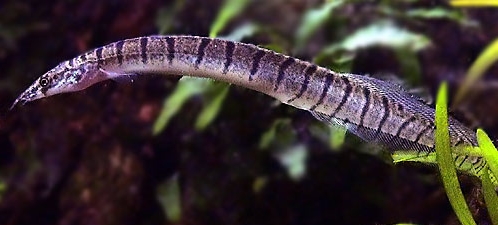
也就是Devario sondhii (=Danio sondhii), 在過去被稱為"泉水斑馬魚", '火紅金線斑馬"或"火燄金燈". 此魚一直到2007年才輸入英國, 而在台灣過去曾經有少數的輸入記錄. 與產於印度的Devario acuticephala在表型上非常相似. 這條魚在外型上或許會另人想到"橘子燈"(Microrasbora rubescens)(見rva的圖), 也因此一直有人推測rubescens會不會根本就應該歸屬於Devario呢? (見petfrd的討論) 魚類學者方芳曾在2003年針對亞洲產的小丹魚類的親緣關係進行形態學研究, 在當時的研究中, 橘子燈的系統分類地位並未被釐清, 而方博士等於2009年發表於Zoologica Scripta的文章利用多個基因片斷資訊成功地解析了相關魚類的親緣關係, 並發現橘子燈與其它Devario的關係呈現nested的情況, 橘子燈本身為Microrasbora的模式種, 這難道意味著Microrasbora應該併入Devario嗎? 由於橘子燈與Devario並不具有顯著的形態共衍徵, 再加上不同的分子資訊並未給予一致的答案, 因此Microrasbora是否應成為Devario的同物異名? 或應將Devario進行拆解? 得等待更多的證據. 原本被置於Microrasbora的其它小型鯉科魚類, 如藍色霓虹則被建議移入一個新屬, Microdevario.
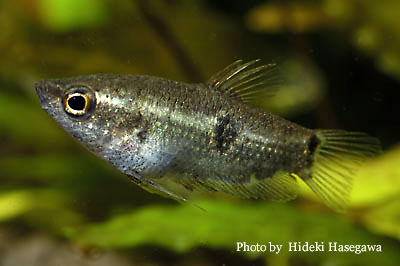 其實就是眼斑飛船 (Parasphaerichthys ocellatus) (=Sphaerichthys ocellatus). 不常進口的可愛小型口孵型迷鰓魚, 對於這類極端害羞又敏感的魚來說, 把牠們養在水草濃密的單種飼養缸大概是最好的辦法, 其實幾種小型飛船還有印度火箭這類的魚大概都有這樣的問題, 因為太害羞了, 所以混養性不高, 再加上對同種個體的攻擊性高(如韋蘭提飛船), 所以若要飼養數對以上的個體, 最好使用大一點的水族箱, 要不然就是比照短鯛的規格一對單缸飼養, 有關飼養的注意事項可參考此處的說明, 其繁殖行為可參考Ralf Britz等人於1995年發表於Japanese Journal of Ichthyology的文章.魚隻來源: 石頭水族 (台北)
圖片連結: allabout.co.jp
 文獻來源: Wu Y, Rovito SM, Papenfuss TJ, Hanken J. 2009. A new species of the genus Paramesotriton (Caudata: Salamandridae) from Guangxi Zhuang Autonomous Region, southern China. Zootaxa 2060: 59-68. Abstract A new species of Asian warty newt, Paramesotriton ermizhaoi, is described from Guangxi Zhuang Autonomous Region in southern China. This species is easily distinguished from other congeners by external morphology and osteology. Phylogenetic analyses based on mitochondrial data place P. ermizhaoi as a possible sister taxon to P. hongkongensis and P. chinensis. The number of trunk vertebrae varies from 12 to 13 in the new species. The relationship between P. ermizhaoi and a potentially new Pachytriton species (Pachytriton C), and the Guangxi population of P. chinensis is briefly discussed.
 文獻來源: Arnold EN. 2009. Relationships, evolution and biogeography of Semaphore geckos, Pristurus (Squamata, Sphaerodactylidae) based on morphology. Zootaxa 2060: 1-21.
Abstract
The Sphaerodactylid gecko genus Pristurus has at least 20 recognised species in Arabia, the Socotra archipelago, and northeast Africa with an isolate 4500km away in Mauritania. Analysis of nineteen variable morphological characters in the Sphaerodactylidae suggests Pristurus is most closely related to Quedenfeldtia of Morocco and then successively to the Spaerodactylini and Saurodactylus. This contrasts with recent studies using nuclear DNA, which place Pristurus in a basal polychotomy in the family. If the molecular tree is correct, there must have been considerable parallelism in anatomy in these taxa. Within Pristurus, parsimony analysis was carried out on a set of 72 variable morphological characters (equivalent to 86 binary ones) from external features, skeleton, musculature and behaviour. Apparent relationships are as follows: P. celerrimus (P. insignis, P. insignoides) (P. guichardi (P. socotranus (P. abdelkuri (P. rupestris, P. popovi, P. flavipunctatus, P. gallagheri, P. adrarensis, the Spatalura clade)))). Relationships within the Spatalura clade are: (P. minimus, P. simonettai) (P. crucifer, P. phillipsi (P. somalicus (P. saada (P. collaris (P. ornithocephalus, P. carteri))))). The more basal Pristurus were apparently primitively heliothermic rock climbers with one lineage becoming tree dwelling. These forms are now confined to the North Oman mountains of eastern Arabia and the Socotra archipelago and may have been replaced elsewhere in Arabia and perhaps northern Africa by a radiation of more morphologically advanced species. Most of these have similar niches to the more primitive forms, but one lineage that gave rise to the Spatalura clade became ground dwelling and partly nocturnal. Many morphological changes on the phylogeny of Pristurus may be functionally associated with shifts in ecology and behaviour.
圖片連結: どうぶつ共和国WOMA
 文獻來源: Thompson GG, Clemnte CJ, Withers PC, Fry BG. 2008. Is body shape of varanid lizards linked with retreat choice? Australian Journal of Zoology 56: 351-362. [線上摘要]
蜥蜴的體型與大小倒底被什麼樣的發育, 演化以及環境因子所影響, 一直是演化生態學者有興趣的課題. 巨蜥屬內在體型以及"撤退選擇行為"(retreat choice)上的多樣化在脊椎動物中是相當特別的例子. 所謂的retreat choice其實就是指遇到危險時所採取的策略, 而這篇文章的目的就是想釐清各式巨蜥的體型大小與快閃策略是否具有關聯性. 他們將巨蜥閃躲時的策略分成四種: 藏進石縫中, 閃進地道裏, 跑進石頭下或樹洞中, 或直接溜到樹上. 他們使用了25種印度洋澳太區的巨蜥做為研究對象, 利用1038bps的NADH-2 gene序列重建牠們之間的演化關係, 然後再將針對這四種行為映象在這個演化關係上是否呈現逢機分布進行統計分析. 結果顯示會閃進石縫裏的巨蜥具有較扁平的身體與較長的尾部, 而土遁種類的前後足上臂較長. 然而不同的快閃策略與親緣關係無關, 這也就是說體型大小與快閃方式的選擇比起棲地類型等因素關聯較強. 但是這篇文章也指出不同的快閃策略倒底是演化的起因或產物還有待討論. 此外, 這篇文章也提供飼養者另一個思考方向, 也就是針對"樹棲"或"地棲"種類營造不同的人工飼養環境時, 應該要更全面地考量巨蜥各種行為的需求, 而不只是飼主的方便.
Abstract
In our earlier analysis of Varanus body shape, size was a dominating factor with some qualitative phylogenetic patterns and grouping of species into ecological categories. With a phylogeny and an improved capacity to account for the effects of size, we have reanalysed our morphometric data for male Australian goannas (Varanus spp.) using an increased number of specimens and species to examine whether variations in body shape can be accounted for by retreat choice, as it can for Western Australian Ctenophorus dragon lizards. After accounting for body size in the current analysis, four ecotypes based on retreat choice (i.e. those that retreat to oblique crevices between large rocks or rock faces, those that retreat to burrows dug into the ground, those that retreat to spaces under rocks or in tree hollows, and those that retreat to trees but not tree hollows) accounted for much of the variation in body shape. There is a phylogenetic pattern to the ecotypes, but accounting for phylogenetic effects did not weaken the link between body shape and ecotype based on retreat choice. This suggests that there are large differences in body shape among ecotypes, and shape is relatively independent of phylogeny. The strong link between shape and choice of retreat site in Varanus spp. is consistent with that for Ctenophorus spp. We speculate on why there might be a strong link between retreat choice and body shape for both Varanus and Ctenophorus.
圖片連結: Thor Hakonsen的flickr相本
 Thomson & Georges才在2009年為了"Elseya latisternum"建立了Myuchelys這個屬, 但奇怪的是, 他們沒注意到同為澳洲人的Richard Wells早在2007年就為E. latisternum及其它幾個種建立了Wollumbinia這個屬. 兩者所指定的模式種都是一樣的, 也就是E. latisternum, 而兩個屬所包含的物種, 也就是bellii, georgesi以及purvisi也完全一樣. 真的不知道Thomson & George是不是文獻讀得不夠才會寫這篇文章? 然後審稿者為何如此不查? 忽略了一個事實上已被使用兩年左右的新屬名, 而竟然讓這篇2008年底才投稿的文章被登出來, 直接成為一個同物異名(junior synonym), 這個例子也告訴我們, 做一個好的分類學者一定要廣博地熟讀許多的文獻, 否則只會徒然造成使用者的困擾. 此外剛出刊的Extra Creeper也將Wollumbinia的原文翻譯並配合精采的圖文解說.
圖片連結: Chelidphile


 Corydoras pastazensis 帕斯塔茲鼠 x 4
Corydoras orcesi Peru 奧希斯鼠 (秘魯產) x 3
Corydoras reynoldsi longnose Colombia 長吻雷諾鼠 (哥倫比亞產斑點型) (=奧希斯鼠, 哥倫比亞產) x 4
Polypterus bichir lapradei 鱷魚恐龍 (東南亞人工繁殖魚) x 2
Tetraodon erythrotaeniata (印尼)紅線娃娃 x 2
今天的重點是所謂的帕斯塔茲鼠(Corydoras pastazensis), 奧西斯鼠(Corydoras orcesi)與長吻雷諾鼠(Corydoras reynoldsi longnose, =CW013)之間的鑑定問題. 上週有一批名為"長吻雷諾鼠"的魚到了, 本以為真的是"長吻雷諾鼠", 不過看到實魚之後發現...怪怪的, 看起來好像orcesi, 這是怎麼一回事呢? 而最近半年進口到台灣的, 所謂pastazensis與orcesi的鑑定似乎也有些問題, 訂了pastazensis可能來了orcesi, 或是訂了orcesi但到貨的是pastazensis. 我們甚至在某些盤商與零售業者看到以"帕斯塔茲鼠"販賣的皇冠豹鼠(Corydoras delphax)甚至是長鼻雙色鼠(C. amandajanea). 即始是許多人經常參考的I love Corydoras網頁也出現模稜兩可的資訊. 在該網頁上所呈現的C. pastazensis照片中包含了所謂的C. "bonita"與"C. Johanna" (誤拼為Johana). 後兩者被一般愛好者的認定中就是"orcesi" (Johanna這個名字是秘魯出口商叫出來的). 然而I love Corydoras所顯示的"orcesi"看起來確像是??? 反正不是orcesi就對了. 再看到該網頁的長吻雷諾鼠, 最下面的幾張照片顯示的是"斑點型"(spotted), 有人分得出來這個斑點型與orcesi之間有什麼差異嗎? 好吧, 如果硬是要把這些"商品"分類的話, 目前在市面上大概可以看到以下幾個"帕斯塔茲-奧西斯-長吻雷諾鼠群"的"形態種"(morpho species):
另外, 秘魯進口的C53(長吻海盜鼠), 有些個體也有類似pastazensis的表現(假設我們看到的有胸部黑斑的個體真的是C53的個體變異), 而部份的C38個體也有背鰭下黑斑擴大的情況, 這增加了正確鑑定這些鼠魚的難度與解析牠們之間關係的複雜性. 好吧, 講了半天只是在談流通於台灣水族市場上這些"商品"的鑑別, 但是Weitzman以及Nijssen當年發表用的模式標本長什麼樣子呢? 根據All Catfish Species Inventory所呈現的模式標本資訊, orcesi的正模標本(採自厄瓜多境內的Río Conambo)(上圖)與我們一般所認知的orcesi看起來是吻合的, 而pastazensis的正模標本(中圖)則是採自厄瓜多的Río Bobonaza), 看起來和一般認知的pastazensis真得很像嗎? 其實我不確定耶. 目前這些令人困惑的魚都已經定序了, 有結果後再向各位報告了.
魚隻來源: 石頭水族, 台族水族, 七彩水族(民權東路)
圖片連結: オオツカ熱帯魚, All Catfish Species Inventory
 整件事情其實是愛丁堡大學所舉辦的國際科學節的節目之一, 這個節目就是廣徵鬼照片並邀請專家與大眾對這些照片進行討論. 聯合報在3/29的報導中特別報導了所謂的古堡鬼魂的照片, 若進入這些入選照片的網頁, 便可看到這張攝自澳洲伯斯水族館的照片. 拍攝者認為右上角明顯有一個可能是鬼魂的臉, 不過大多數的回應者認為那只是反光造成的 (可能就玻璃被遊客摸得油油的, 然後就一整個剛好.....).
 今天下午逛了一下民權東路水族街, 發現有兩家店出現"紅線娃娃"(Tetraodon erythrotaenia)這條魚, 不過同一條魚, 但兩家的標示卻不同, 一家標示為"澳洲紅線娃娃", 另一家則是"印度紅線娃娃", 這是怎麼一回事? 難道這種四齒魨的分布這麼神奇嗎? 從印度到澳洲都有? 倒底是那一家出錯? 或者這條魚的分布真的這麼廣泛? Tetraodon erythrotaeniag乃由1842-1860年期間服務於荷屬東印度公司的醫師與魚類學者Pieter Bleeker於1853年所發表的物種. 在他的著作Vierde bijdrage tot de kennis der ichthyologische fauna van Celebes中已經明白地指出這條魚分布於印尼所屬的摩鹿加群島以及數個伊里安查亞(Irian Jaya)西側的小島週邊區域, 也就是說, 不論與印度或澳洲一點關係也沒有. 那麼這樣的錯誤可能是從何而來呢? 可能是這條魚最初引進台灣時, 有人英文不好, 把India和Indonesia搞混了? [經查是2100種那本書就將其稱作"印度紅線娃娃", 所以很可能是其日文版譯名就錯了] 另一個可能是Fishbase或其它網頁經常指出這條魚分布於"Australasia". Australasia指的是一個廣大的區域, 也就是澳洲以北的南太平洋至印尼所屬大多數島嶼的區域, 但絕對不是"澳洲"(Australia). 這條魚最好就只叫紅線娃娃就好, 或改稱印尼紅線娃娃. 至於有某網頁指稱這條魚分布於保護區所以採集困難, 目前完全找不到可信的資料支持這樣的說法.
圖片連結: Aqua Grace
 文獻來源: Elwood RW, Appela M. 2009. Pain experience in hermit crabs? Animal Behaviour (in press). [摘要網址] Abstract Pain may be inferred when the responses to a noxious stimulus are not reflexive but are traded off against other motivational requirements, the experience is remembered and the situation is avoided in the future. To investigate whether decapods feel pain we gave hermit crabs, Pagurus bernhardus, small electric shocks within their shells. Only crabs given shocks evacuated their shells indicating the aversive nature of the stimulus, but fewer crabs evacuated from a preferred species of shell indicating a motivational trade-off. Some crabs that evacuated attacked the shell in the manner seen in a shell fight. Most crabs, however, did not evacuate at the stimulus level we used, but when these were subsequently offered a new shell, shocked crabs were more likely to approach and enter the new shell. Furthermore, they approached that shell more quickly, investigated it for a shorter time and used fewer cheliped probes within the aperture prior to moving in. Thus the experience of the shock altered future behaviour in a manner consistent with a marked shift in motivation to get a new shell to replace the one occupied. The results are consistent with the idea of pain in these animals.
另請見Sciencedaily的介紹
圖片連結: wikipedia

 文獻來源: Praschag P, Hundsdoerfer, Uwe F. 2009. Further specimens and phylogenetic position of the recently described leaf turtle species Cyclemys gemeli (Testudines: Geoemydidae). Zootaxa 2008: 29–37. [全文下載]Fritz U, Guicking D, Auer M, Sommer RS, Wink M, Hundsdoerfer AK. 2008. Diversity of the Southeast Asian leaf turtle genus Cyclemys: how many leaves on its tree of life? Zoologica Scripta 37(4): 367-390. [連結]
俗稱葉龜(leaf turtle)(或稱圓龜, 攝龜)的Cyclemys屬在過去一直只被認為有1-2種, 一種是"黑肚子的", 而另一種是"白肚子"的. 然而Fritz et al.(2008)的文章顯示這個屬的已知物種應該有7種, 而且黑肚子的種類並不形成一個單系群, 每一個在形態上都難以被辨識. Praschagi et al. (2009)的文章則再進一步地確認印度圓龜(Cyclemys gemeli)的有效性及與灰舌圓龜(C. fusca)在地理分布上的界限. 台灣過去所進口的Cyclemys大多以C. dentata的名義進口, 然而正確的鑑定可能需仰賴足夠的分子證據才能確認. 這篇文章的作者也指出無論是IUCN或其它相關的物種瀕危程度評估都應該重新考量Cyclemys的多樣性.
此外請參見Lieb所發表的一篇有關Cyclemys各種譯名與分類文章閱讀心得的文章
 文獻來源: Arunachalam, M. & Muralidharan, M. (2009): Nemacheilus stigmofasciatus, a new species of nemacheiline loach (Cypriniformes: Balitoridae) from the Western Ghats, India. Journal of Threatened Taxa 1 (3): 147-150. [全文下載]
Abstract
A new nemacheiline loach is described from the Seethanathi river of the Western Ghats, Karnataka. The new species differs from others of the genus in having an incomplete lateral line extending up to the end of the pelvic fin, shorter snout (35.9 -39.4% of HL) and bigger eyes (28.1-31.3% of HL). Notable colour variation is present in the bands on the back (11-13) and blotches (6-8) evenly spaced along the lateral line.
 文獻來源: Spinks PQ, Thomson RC, Shaffer HB. 2009. A reassessment of Cuora cyclornata Blanck, McCord and Le, 2006 (Testudines, Geoemydidae) and a plea for taxonomic stability. Zootaxa 2018: 58–68. [全文下載]
中國與東南亞的閉殼龜(箱龜)(廣義的Cuora)一直是龜鱉保育上的重要話題, 然而在保育生物學上, 確認"保育的單位"以及"保育措施的標的物種是什麼"是兩個最基本的命題. 也就是說, 如果連生物本身的鑑定與分類還存在著問題, 那麼就奢談有意義的保育與資源利用了 (包含寵物, 龜板與龜肉交易). 閉殼龜的分類在近年有三個主要的難題, 首先是為了偽造高經濟價值的"三線閉殼龜"由人工製造的跨屬或種間雜交個體造成科學上的混亂; 其次是閉殼龜在中國與東南亞的嚴重瀕危與棲地破壞使得多數被用於研究的個體缺乏可信的地理資訊, 因此要釐清小地理尺度的族群遺傳與基因多樣性是有困難的; 最後是東亞與東南亞地澤龜科種間與屬間頻繁的種間雜交所造成的基因滲漏(introgression)使的近年大多數的研究都指出某些"著名"的閉殼龜物種, 例如潘氏閉殼龜與安徽閉殼龜, 或花背箱龜存在著極大的鑑定疑義. 這篇文章針對Blanck等人於2006年在一本三線閉殼龜的專書中所描述的新物種, "麗圓閉殼龜"(及其梅氏亞種), 以族群遺傳學方法加以檢測其有效性. 結果顯示Cuora cyclornata與其梅氏亞種無論在mtDNA或nDNA所提供的訊息上都無法與三線箱龜分開, 而Blanck等人上載到GenBank上的多數三線箱龜序列則顯然是來自於雜交個體.
此外, 以下網路轉載文章對閉殼龜的鑑定與人工養殖有著相當有趣的說明:
圖片連結: wikipedia
 齒鯉科(Cyprinodontidae)在全球的分布僅限於北美, 中美加勒比海底區, 南美的北部, 阿拉伯半島與環地中海區域. 根據化石的記錄牠們也曾經分布至中亞如哈薩克等地區, 然而隨著後冰河期的變遷而呈現目前這種不連續的分布. 齒鯉科的起源與分化與勞亞大陸(Laurasia)與岡瓦納大陸分離, 以及古地中海的封閉有著密切的關係. 一般認為分布於現今阿拉伯半島至地中海西側乾燥地區的Aphanius(隱鱂屬)的分化發生在古地中海封閉之後 (如Hrbek & Meyer, 2002). 在水族市場上, 這類的多年生卵生鱂魚並不常見, 即始是豔麗如古巴鱂屬(Cubanichthys), 其流通量還是很低. 過去在台灣有個陽春魚種叫"美國旗"(Jordanella floridae), 但是這玩意兒已經有多年不見, 從此齒鯉科就幾乎在台灣的水族市場上消失. 所謂的"沙漠藍珍珠鱂"(Aphanius mento)產於地中海西側, 通常只在歐美, 日本或香港的鱂魚愛好者間流通, 我們過去在台灣還沒見到過(然後有大大馬上吐槽說台灣很多), 不過現在東南亞繁殖場已經有人工繁殖個體提供, 因此獲得這條魚就變得容易多了. 許多愛好者的經驗指出Aphanius mento屬於比較暴譟的魚, 不過對於鹽度, 溫度與水質的適應範圍非常廣, 因此日本方面認為甚至可以留在室外渡冬也沒有問題.
圖片連結: Killi Fish Netherland
 文獻來源: Thomson S, Georges A. 2009. Myuchelys gen. nov. —a new genus for Elseya latisternum and related forms of Australian freshwater turtle (Testudines: Pleurodira: Chelidae). Zootaxa 2053: 32–42 (2009). [摘要下載]
Abstract Myuchelys, a new genus, is erected for a well supported clade of Australasian freshwater turtles; its establishment resolves an unacceptable paraphyly in relationships among species of the genus Elseya. Molecular and morphological evidence indicates that the closest relationship of the new genus is with Emydura, not the redefined Elseya.
癩頸龜屬(Elseya)的分類一直有一些歷史上的問題. Gray在1867年建立Elseya屬時並沒有指定模式種, 而在當時的描述中包含了澳北盔甲龜(E. dentata)以及鋸齒盔甲龜(E. latisternum)兩個種, 而其模式種則是被後來的研究者指定為E. dentata. Elseya的單系性長期以來被質疑, 也因此一直有學者嘗試著把這個屬拆解成數個小屬, 不過一直沒有解決Elseya, 若包含E. latisternum是個駢系群的問題. 因此這篇文章的作者建議把E. latisternum置入一個新屬 - Myuchelys, 而這個新屬事實上與Elseya不具有最近的親緣關係, 反而與Emydura屬的關係較近. 此處描述了此類側頸龜的飼養.
圖片連結: Stewart Macdonald的flickr
 Puntius pentazona 五間鯽 x 6 (另見此處的美照)
Boehlkea fredcochui 鑽石藍燈 x 10 (不是藍燈喔, 相關故事見此)
Varanus dumerilii 杜氏巨蜥 x 1
Varanus boehmei 金點樹巨蜥 (=黑黃巨蜥) x 1
Tribolonotus novaeguineae 新幾內亞鷹蜥 x 2
其實今天最喜歡的是五間鯽. 這條魚與圈圈鯽(P. rhomboocellatus)曾有一段時間被當成同種的異亞種, 不過近年的分類意見傾向於把兩者視為獨立的兩種. 這條魚在市面上其實並不多見, 能見度不算很高, 感謝icenvoy大大閒逛時發現.
魚隻來源: 哲園水族(台中), 娃娃魚水族(台中)
圖片連結: wikipedia


 Danio choprai (=Danio choprae) 金虹帶斑馬 (=虹帶斑馬) x 5